March 20, 2017: Reading the Bhagavad Gita in the Age of Trump

FEBRUARY 6, 2017, BHAGAVAD GITA TALK #2: NONBEING CAN NEVER BE; BEING CAN NEVER NOT BE. BOTH THESE STATEMENTS ARE OBVIOUS TO THOSE WHO HAVE SEEN THE TRUTH.

Soon after we began reading the Bhagavad Gita, I was listening to a radio news show, I think it was NPR’s All Things Considered, and learned that Steve Bannon is a big fan of the Gita. Checking this out online, I discovered that Heinrich Himmler was also an admirer. He evidently kept a leather bound copy with him at all times. So we have Bannon, the architect of Trump’s policy agenda, and Himmler, the architect of the Nazi “Final Solution,” twisting the ideal of dharma to serve their twisted worldview. Two sociopaths fixated on the Gita’s notion of righteous war to justify their own pathologies. If you want an example of the dangers of belief, I give you this: Himmler believed Hitler was an incarnation of Krishna. One can only hope Bannon is not similarly deluded about the monster he serves.

It does give one pause.
And begs the question: How do we discern truth from belief?

The Bhagavad Gita may use the notion of “righteous war” to start a conversation. But the conversation is not about war. It’s about consciousness. The conversation between Arjuna and Krishna is a mirror of the conversation that goes on inside of us all the time. The conversation between the small self or ego (what we refer to in Yoga as the “I-maker”) and the Great Self of the Heart. And by “Heart,” I mean the ineffable hugeness that doesn’t speak in words. It’s more like a quivering or shimmering from deep within us. In those miraculous moments when we ground there, we embody everything the Gita teaches. In fact, in those miraculous moments, we are the Gita.

What Bannon doesn’t understand now and what Himmler didn’t understand then, is that we don’t go to war against the “other,” we go to war against that inside of us which creates the idea of “other.” We go to war inside of ourselves against the notion that we are somehow separate from and entitled to destroy that “other.” We go to war against this outmoded paradigm that has always been questionable and has demonstrated over a few thousand years that the only thing it excels at is making a tremendous mess of everything it touches.

We have to read the Gita the same way we should live our lives. We have to slip beneath the surface, read between the lines. We have to probe deeper and deeper, within a text, within ourselves, until the mind becomes so spacious, so still, that the “I”’ that drives the historical, cultural, psycho-emotional, and spiritual narratives that rule us ceases to be. Only in that stillness is the possibility of insight, and only in that insight, the possibility of truth. Anything that comes before that must be questioned.

I was talking with someone recently who was feeling very uncertain about her own gifts, and along with that, judging herself for not being more certain. This is the trap of dualistic thinking. It’s not about hard-edged certainty or soft edgeless uncertainty. Certainty and uncertainty are opposite poles of a stuckness that is quite destructive either way. What we want to develop is clarity. Which is neither certainty nor uncertainty. It’s just clarity. In that koan-like way Verse 2.16 so eloquently sings: “Nonbeing can never be; being can never not be. Both these statements are obvious to those who have seen the truth.’

Here’s my dharma talk from February 6. Which was Bhagavad Gita Talk #2, a rather freewheeling contemplation on the first forty or so verses from Chapter Two, The Practice of Yoga.

Here are the verses from this talk.  (If you’re visiting this blog for the first time, please note we’re working with Stephen Mitchell’s translation of the Bhagavad Gita. See my last post for more on that.)

Although you mean well, Arjuna
your sorrow is sheer delusion.
Wise men do not grieve
for the dead or the living.

Never was there a time
when I did not exist, or you,
or these kings; nor will there come
a time when we cease to be.

Just as, in this body, the Self
passes through childhood, youth,
and old age, so after death
it passes to another body.

Physical sensations—cold
and heat, pleasure and pain —
are transient: they come and go:
so bear them patiently, Arjuna.

Only the man who is unmoved
by any sensations, the wise man
indifferent to pleasure, to pain,
is fit for becoming deathless.

Nonbeing can never be;
being can never not be.
Both these statements are obvious
to those who have seen the truth.

The presence that pervades the universe
is imperishable, unchanging,
beyond both is and is not:
how could it ever vanish?

These bodies come to an end;
but the vast embodied Self
is ageless, fathomless, eternal.
Therefore you must fight, Arjuna.

If you think the Self can kill
or think that it can be killed,
you do not well understand
reality’s subtle ways.

It never was born; coming
to be, it will never not be.
Birthless, primordial, it does not
die when the body dies.

Knowing that it is eternal,
unborn, beyond destruction,
how could you ever kill?
And whom could you kill, Arjuna?

Just as you throw out used clothes
and put on other clothes, new ones,
the Self discards its used bodies
and puts on others that are new.

The sharpest sword will not pierce it;
the hottest flame will not singe it;
water will not make it moist;
wind will not cause it to wither.

It cannot be pierced or singed,
moistened or withered; it is vast,
perfect and all-pervading,
calm, immovable, timeless.

It is called the Inconceivable,
the Unmanifest, the unchanging.
If you understand it in this way,
you have no reason for sorrow.

Even if you think that the Self
is perpetually born and perpetually
dies—even then, Arjuna,
you have no reason for your sorrow.<

Before birth, beings are unmanifest;
between birth and death, manifest;
at death, unmanifest again.
What cause for grief in all this?

Some perceive it directly
in all its awesomeness; others
hear of it and never know it.

This Self who dwells in the body
is inviolable, forever;
therefore you have no cause to grieve
for any being Arjuna.

Know what your duty is
and do it without hesitation/
For a warrior, there is nothing better
than a battle that duty enjoins.

Blessed are the warriors who are given
the chance of a battle like this,
which calls them to do what is right
and opens the gates of heaven.

But if you refuse the call
to a righteous war, and shrink from
what duty and honor dictate,
you will bring down ruin on your head.

Decent men, for all time,
will talk about your disgrace;
and disgrace, for a man of honor,
is a fate far worse than death.

These great heroes will think
that fear has driven you from battle;
all those who once esteemed you
will think of you with contempt.

And your enemies will sneer and mock you:
“The mighty Arjuna, that brave man—
he slunk from the field like a dog.”
What deeper shame could there be?

If you are killed, you gain heaven;
triumph and you gain the earth.
Therefore stand up, Arjuna;
steady your mind to fight.

Indifferent to gain or loss,
to victory or defeat,
prepare yourself for the battle
and do not succumb to sin.

This is philosophy’s wisdom:
now hear the wisdom of yoga.
Armed with this understanding,
you will shatter your karmic bonds.

On this path no effort is wasted,
no gain is ever reversed;
even a little of this practice
will shelter you from great sorrow.

And as often is the case, the final word goes to Mary Oliver:

HOW TURTLES COME TO SPEND THE WINTER IN THE
AQUARIUM, THEN ARE FLOWN SOUTH AND
RELEASED BACK INTO THE SEA

Somewhere down beach, in the morning, at water’s edge, I found
   a sea turtle,
its huge head a smoldering apricot, its shell streaming with
   seaweed,
its eyes closed, its flippers motionless.
When I bent down, it moved a little.
When I picked it up, it sighed.
Was it forty pounds, or fifty pounds, or a hundred?
Was it two miles back to the car?
We walked a little while, and then we rested, and then we
   walked on
I walked with my mouth open, my heart roared.
The eyes opened, I don’t know what they thought.
Sometimes the flippers swam at the air.
Sometimes the eyes closed.
I couldn’t walk anymore, and then I walked some more
while it turned into granite, or cement, but with that
   apricot-colored head,
that stillness, that Buddha-like patience, that cold-shocked
   but slowly beating heart.
Finally, we reached the car.

                                                       ***

The afternoon is the other part of this story.
Have you ever found something beautiful, and maybe just in time?
How such a challenge can fill you!
Jesus could walk over the water.
I had to walk ankle-deep in the sand, and I did it.
My bones didn’t quite snap.

 Come on in, and see me smile.
I probably won’t stop for hours.
Already, in the warmth, the turtle has raised its head, is
   looking around.
Today, who could deny it, I am an important person.

–Mary Oliver, House of Light

March 14, 2017: Reading the Bhagavad Gita in the Age of Trump

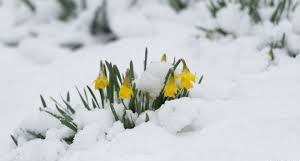
daffodils and snow

JANUARY 30, 2017: BHAGAVAD GITA TALK #1. “ON THIS PATH NO EFFORT IS WASTED”

In the weeks between the November election and January inauguration, the great majority of us on the other side of madness were in shock, beginning to mobilize, but also holding out hope that somehow, some way, this political nightmare would be averted. Time seemed to stand still, and then, it was done. We found ourselves waking up in a whole new reality, waking up in an America we did not recognize, waking up in the age of Trump.

And now it’s March. In just six days it will be Spring. Although here on the East coast we’re being slammed by winter weather we barely had all winter. Last week, sixty degrees and daffodils blooming. Today they’re buried under the snow. The sweet promise of new life and renewal postponed for the time being.

Which brings me to the Bhagavad Gita. When I was younger in my journey, I devoured texts like this one. I couldn’t get enough. These last years though I’ve mostly stayed away from them. Partly it’s the patriarchal language, partly what sometimes seems a jungle of verbiage. At this stage of my life, I way prefer the naked simplicity of Mary Oliver’s poetry and Robert Bly’s Kabir.

And yet, the Bhagavad Gita is a powerful compendium of the yogic system. And has a great deal to say about waking up, about the difference between authentic power and something that pretends to be. About true greatness of soul and that empty charade that is grandiosity and smallness. Like so many of India’s ancient wisdom texts, no one knows for sure when this one was written. Scholars date it sometime between the fifth century B.C.E and first century C.E.The wonder of it is, it’s incredibly relevant for now.

Because along with articulating the philosophy and psychology of Yoga, the Gita offers a rather precise technology for strengthening ourselves from the inside out, so we can not only meet, but act effectively, to counter the dangers of this time. There is so much work to do. So many moving parts. So many different voices and needs to attend to. It’s easy to lose focus, burn out, numb out, and feel overwhelmed. Working with the Gita offers a steadying, sobering, and heart-drenched medicine for standing strong in the face of that and those who dare to cause harm…

The edition we’re using is Stephen Mitchell’s Bhagavad Gita: A New Translation. My scholar friends will thumb their noses, but I do like his version. Perhaps it’s Mitchell’s long training in Zen. True to the text and written with great respect and reverence, there’s a spareness in his writing I respond to. The Introduction alone is superb. Mitchell really gets it! Here’s how he opens:

One of the best ways of entering the Bhagavad Gita is through the enthusiasm of Emerson and Thoreau, our first two America sages. Emerson mentions the Gita often in his Journals, with the greatest respect…

It was the first of books; it was as if an empire spake to us, nothing small or unworthy but large, serene, consistent, the voice of an old intelligence which in another age and climate had pondered and thus disposed of the same questions which exercise us.

What a revelation the Gita must have been for minds predisposed to its largehearted vision of the world. And what a delight to stand behind Emerson and Thoreau, reading over their shoulders as they discover this “stupendous and cosmogonal” poem in which, from the other side of the globe, across so many centuries, they can hear the voice of the absolutely genuine. Here is a kinsman, an elder brother, telling them truths that they already, though imperfectly, know, truths that are vital to them and to us all. In the Gita’s wisdom, as in an ancient, clear mirror, they find that they can recognize themselves….

And here’s how he closes:

The healthiest way to begin reading and absorbing a text like the Bhagavad Gita is to understand that ultimately it has nothing to teach. Everything essential that it points to—what we call wisdom or radiance or peace—is already present inside us. Once we have practiced meditation sincerely and seen layer after layer of the inauthentic fall away, we come to a place where dualities such as sacred and profane, spiritual and unspiritual fall away.

Zen Master Hsueh-feng asked a monk where he had come from.The monk said, “From the Monastery of Spiritual Light.”

The Master said, “In the daytime, we have sunlight, in the evening, we have lamplight. What is spiritual light?”

The monk couldn’t answer.

The Master said, “Sunlight. Lamplight.”

In that place, God is the ground we walk on, the food we eat, and the gratitude we express, to no one in particular, as naturally as breathing.

* * * * *

How’s that for a beautiful (and over the top tantric) definition of God.

Here’s the audio of my first Dharma Talk on the Gita. This is from January 30, 2017. I also want to add that for no rational reason I can articulate, but from the shakti that informs my work, the mantras we’ve been chanting this cycle are Om Tara Tuttare Ture Swaha and Namo Kuan Shih Yin P’u-Sa. This talk opens with a just shy of 3-minute explication of the Tara mantra.

Monday, November 7, 2016

I cannot believe it is already November. And thank goddess the presidential campaign is over tomorrow.Or let us hope it ends tomorrow with no re-count challenges…

At class last week, we were contemplating the five koshas as described in the Taittiriya Upanishad. A fancy way to articulate the various levels (aka bodies) that weave through the ultimate oneness of our human being-ness. The more I think about it, the more I think that while this way of breaking it down into categories has its place in the work of developing mastery, I do believe Mary Oliver says it all way more beautifully….

WHAT CAN I SAY
-Mary Oliver

What can I say that I have not said before?
So I’ll say it again.
The leaf has a song in it.
Stone is the face of patience.
Inside the river there is an unfinishable story
  and you are somewhere in it
and it will never end until all ends.

Take your busy heart to the art museum and the
   chamber of commerce
but take it also to the forest.
The song you heard singing in the leaf when you 
   were a child
is singing still.
I am of years lived, so far, seventy-four,
and the leaf is singing still.

When I was meditating this morning, I found my mind contemplating the question, “Why?” Why do I meditate?  Why have I been doing this practice now for nearly forty years? What have I received? Have I done it to receive anything? What’s the bloody point of it all? Why do I teach it to others?

And I remembered, being in high school, maybe my junior year. 1964 or 1965. I was reading Herman Hesse’s Siddhartha. I can still feel myself lying on the living room couch in my family’s home absorbed in that narrow paperback. And I came to the end of the story, where he has attained something wonderful. He has attained stillness. And every cell in my being started to pulsate. I didn’t know how to find what he found, but in that moment, my quest began…

So why do I meditate? All those years in Siddha Yoga formed a habit. What began as a quest and became a rigid following of  ashram discipline — (really rather fear-based if I speak the truth to you now) — just became something I do.

Like breathing. Or sleeping. Or drinking chai.

And at this point in my life, to borrow a phrase from Mary Oliver, I am of years lived, so far, sixty-eight… And find I don’t need a reason. In fact, I question if having a reason is actually counter to the practice.

Meditating may contribute to my health and vitality —
may help to anchor my insight and intuition —
may foster an inner glow —
but I realized this morning that I don’t do it for any of those reasons.

I just meditate to meditate.

If I have a reason, it’s something like for the sheer joy of being alive and experiencing the sometimes beautiful, sometimes terrible, sometimes wonder-filled, sometimes terrifying life/death dance of life.

Which is more than enough reason for me.

* * * *

Tomorrow is Election Day in the USA. If you’re a US citizen, please vote!!! Because even though it seems like it barely makes a difference. That the status quo remains the status quo. That our so-called leaders remain in the pockets of corporate lobbyists. Still, somehow, in the big picture, it does matter. If only to elect someone who understands the climate crisis is here and it is real. And that is Hillary Clinton. Whether she’ll be able to do anything about it, probably only those incremental steps she’s famous for. And whether incremental steps are enough… I don’t think so. Nevertheless, I’m voting for Hillary. Not because she’s inspired me as a candidate. (She has not.) Not because she’s a woman. (To me it’s less about gender and more about consciousness.) Not because I particularly want to see Bill Clinton back in the White House. (It actually kind of creeps me out.) I’m voting for Hillary Clinton because I think she is far and away the best choice we have. And while I don’t agree with all her policies. And have concerns about how enmeshed she is in politics as usual. Still, I have real respect for her intelligence, wonkiness, and discipline. And suspect that although she doesn’t often show it in her public persona, I think she actually cares. And while I don’t think that’s enough. I do think it’s a starting point. We just need to ensure she is elected. And then keep pushing her to govern from that sense of care. Not from fear. Not from greed. Not from a need to dominate. To govern with care for everything that lives and breathes and is of this Earth we all call home…

Communication, Communion, and the Mind According to Yoga…

P1000600_2

I think a lot about listening. What it means to really listen to oneself. What it means to listen to another. What is means to listen to the world. How do we cultivate ears that truly hear. How do we foster a communication between ourselves and everything of our world that makes communion happen. So much gets in the way of that. So much mucks up the clear space within and around us. So that rather than communion, we often end up with separation. We cling to our belief systems. We cling to our stories. We cling to our idea of being right. Which doesn’t let in much space for listening. We’re too busy telling…

Here’s a talk about listening that weaves in yogic teachings on the mind, aka, the Four-Part Psychic Instrument or antahkarana. Like so much passed down through the Hindu Yogic system, this perspective on the mind is quite simple and profound. I unpack it in the talk, but here are the technical terms spelled out.

The four levels of antahkarana or the Four-Part Psychic Instrument

Manas: often translated as mind-stuff. From our western perspective, think of it as your conscious mind.

Chitta: translated in a myriad of ways. From our western perspective, think of it as the unconscious.

Ahamhara: in the yogic system, this is the sense of “I.” Often referred to as the ego.

Buddhi: the discriminating faculty.

Here’s the talk:

And here is a wonderful poem from Mary Oliver who is perhaps one of the greatest listeners we have.


The Fist
Mary Oliver
 
There are days
when the sun goes down
like a fist,
though of course

if you see anything
in the heavens
in this way
you had better get

your eyes checked
or, better still,
your diminished spirit.
The heavens

have no fist,
or wouldn’t they have been
shaking it
for a thousand years now,

and even
longer than that,
at the dull, brutish
ways of mankind—

heaven’s own
creation?
Instead: such patience!
Such willingness

to let us continue!
To hear
little by little,
the voices—

only, so far, in
pockets of the world—
suggesting
the possibilities

of peace?
Keep looking.
Behold, how the fist opens
with invitation.

from Thirst, Beacon Press, 2006.

May 20, 2016: We May As Well Love It Cause It’s Not Going Away…

The last time I checked in here, it was November and I was settling into my new home. What I’d not yet begun to write about was my discovery and subsequent love affair with the Surya Namaskar mantras. These mantras came to me in April 2015 and after a few weeks of singing them, it was clear they were the centerpiece of our next album in The Mantra Project collection. That album, Mantras of the Sun,  released April 22, 2016 and debuted at #2 on iTunes World Music Chart. I’m developing a new blog devoted solely to these mantras and my own contemplations of the Sun. More on that when it goes live. In the meantime, if you’d like to listen or buy it, it’s available wherever music is streamed and/or sold. And if you have any problems finding it online, please visit my website, suzingreen.com.

The Sun mantras are elemental mantras, embodying twelve aspects of the Sun. For me personally, working with them has been an ongoing revelation. Early on in the process, I realized how much I’ve taken this extraordinary star that just happens to be our Sun, for granted.  It is after all the source and sustainer of life on Earth, always there even when we don’t see it. The absolute center of our solar system, it’s way more than a metaphor or archetype. It’s a fully embodied form and rather amazing mirror of our own inner light.

For those who visit this blog who don’t attend class or have not been to Mantras of the Sun concerts, I’ll include the mantras at the end of this post.

We’ve now had many classes constellated around these mantras. Over the coming months, as I’m able to blog here, I’ll post more content from this last year of Monday Night Class. Rather than go back to the beginning however, I’m posting material from this week, Monday, May 16, 2016. The contemplation for this class was “Generosity” and the mantra we focused on was:

om sūryāya namaḥ |
Salutations to Sūrya, the self-luminous light


Here’s the opening dharana: 


As I wrote above, the topic for class this week was “Generosity.” And if you think about the Sun, I think you’ll agree, among its many aspects, generosity is a key one. The Sun shines down on this entire planet, offering its life giving energy in the forms of light and heat and asking nothing, NOTHING, in return. You want a role model for right living, perhaps I should call it “light living,” make friends with the Sun.


Here’s my dharma talk from May 16:

[audio


Here are the poems and the story:

Making the House Ready for the Lord
Mary Oliver

Dear Lord, I have swept and I have washed but
still nothing is as shining as it should be
for you. Under the sink, for example, is an
uproar of mice – it is the season of their
many children. What shall I do? And under the eaves
and through the walls the squirrels
have gnawed their ragged entrances – but it is the season
when they need shelter, so what shall I do? And
the raccoon limps into the kitchen and opens the cupboard
while the dog snores, the cat hugs the pillow;
what shall I do? Beautiful is the new snow falling
in the yard and the fox who is staring boldly
up the path, to the door. And still I believe you will
come, Lord: you will, when I speak to the fox,
the sparrow, the lost dog, the shivering sea-goose, know
that really I am speaking to you whenever I say,
as I do all morning and afternoon: Come in, Come in.


The Place I Want to Get Back To
Mary Oliver
 

is where
in the pinewoods
in the moments between
the darkness
 
and first light
two deer
came walking down the hill
and when they saw me
 
they said to each other, okay,
this one is okay,
let’s see who she is
and why she is sitting
 
on the ground, like that,
so quiet, as if
asleep, or in a dream,
but, anyway, harmless;
 
and so they came
on their slender legs
and gazed upon me
not unlike the way
 
I go out to the dunes and look
and look and look
into the faces of the flowers;
and then one of them leaned forward
 
and nuzzled my hand, and what can my life
bring to me that could exceed
that brief moment?
For twenty years
 
I have gone every day to the same woods,
not waiting, exactly, just lingering.
Such gifts, bestowed,
can’t be repeated.
 
If you want to talk about this
come to visit. I live in the house
near the corner, which I have named
Gratitude.

This post is already so long I’lll end with the mantras and include the Jataka Tale  I told on my next post. Here are the mantras.

THE TWELVE SŪRYA NAMASKAR MANTRAS
ॐ मित्राय नमः
om mitrāya namaḥ |
Salutations to Mitra, the friend of all
ॐ रवये नमः
om ravaye namaḥ |
Salutations to Ravi, whose radiance hums
ॐ सूर्याय नमः
om sūryāya namaḥ |
Salutations to Sūrya, the self-luminous light
ॐ भानवे नमः
om bhānave namaḥ |
Salutations to Bhānu, the bright splendor of light
ॐ खगाय नमः
om khagāya namaḥ |
Salutations to Khaga, who moves through the sky like a bird
ॐ पूष्णे नमः
om pūṣṇe namaḥ |
Salutations to Puṣan, whose cleansing light gives strength
ॐ हिरण्यगर्भाय नमः
om hiraṇyagarbhāya namaḥ |
Salutations to Hiraṇyagarbha, the golden egg resplendent as the sun
ॐ मरीचये नमः
om marīcaye namaḥ |
Salutations to Marīci, the shining particle of light
ॐ आदित्याय नमः
om ādityāya namaḥ
Salutations to Āditya, the son of Aditi, the mother of the gods
ॐ सवित्रे नमः
om savitre namaḥ |
Salutations to Savitṛ, the vivifying power of the sun
ॐ अर्काय नमः
om arkāya namaḥ |
Salutations to Arka, whose flash of light is a song upon the earth
ॐ भास्कराय नमः
om bhāskarāya namaḥ |
Salutations to Bhāskara, the beautiful splendor of light

Sunday, November 29, 2015

    Had someone had told me in early June, that by September I’d have sold my house and moved to an in-town apartment, I would have said, “No way.” Yet here I sit, marveling at the change that brought me here and reveling in the perfection of the timing and lightening of my load.
     One of the many wonders of this stunningly unanticipated shift has been watching my cat Lily adjust to her new home. Lily is ten years old and a creature of profound and sedentary habit. In the language of Yoga we would say she is kapha on steroids, tamasic to the nth degree.  I knew the change would be traumatic for her, but was unprepared for the extent. She spent her first three weeks here hiding under my bed. By the end of the first month, she was slowly emerging. By week six, she’d finally found her groove.
     That’s when I noticed the transformation. And transformation is not a word I associate with cats. Nevertheless, as Lily embraced her new surroundings, she regained that marvelous feline curiosity and a new bounce in her gait. Her eyes looked brighter. Her coat had more shine. Her sedentary habits had slipped away.
     Watching Lily’s transformation was such a confirmation of the yogic impulse to push through limitation. All those narratives, conscious and hidden, that diminish our sense of Self. Physical pain, fears, belief systems, psycho/emotional wounding, habitual patterns, the list of stifling possibilities goes on and on. And as we’ve all experienced so many times, every time we push through these holding patterns, we get bigger. We taste our infinite possibility. We become more of who we actually are. I’ve always known this is true of humans. I had no idea it is also true of cats…
   IMG_2437
    While these individual acts of reclamation may not be enough to transform the toxic narratives that threaten our 21st century world, I think each one adds a drop to the ocean of wisdom, the ocean of light. And one of these days or years or eons from now, that ocean will devour the terrible darkness that knows only how to cause harm.
     For now, we can only do what we can do. Some are called to the front lines. Others work in the unseen corners. But wherever we may be, we can always shift out of stuck patterns. Any small act will do. It can be as simple as saying “yes” if our default is “no,” or “no,” if our default is “yes.” The key is in pushing through our comfort zones. Be they physical, intellectual, emotional, or spiritual. We’ve all had the experience ten thousand times. Every time we move past those self-imposed fences, something wonderful opens up inside.
     I recently fell in love with a new poem from Mary Oliver. She sings this truth so beautifully. If you receive my eNewsletters, you have it in the Thanksgiving blast. If you do not, enjoy…..

Storage
Mary Oliver

When I moved from one house to another
there were many things I had no room 
for. What does one do? I rented a storage 
space. And filled it. Years passed.
Occasionally I went there and looked in,
but nothing happened, not a single 
twinge of the heart.
As I grew older the things I cared 
about grew fewer, but were more 
important. So one day I undid the lock 
and called the trash man. He took
everything.
I felt like the little donkey when 
his burden is finally lifted. Things!
Burn them, burn them! Make a beautiful 
fire! More room in your heart for love,
for the trees! For the birds who own 
nothing–the reason they can fly.

from Felicity, Penguin Books, 2015. Click here to order a copy. 


March 10, 2015: Poems for the Inner Journey

Spring arrives Friday, March 20th at 6:45 PM EDT. And while the light has been returning since the solstice turn, there is something about the equinox, not to mention daylight savings time, that makes it all seem more, how can I say, official. Not that the cosmic movements need any official validation from us mere mortals….

Nevertheless, to honor the light and it’s lengthening return, we’ve been chanting myriad rounds of gayatri-mantra each week. For those visitors to this blog who do not actually attend class — and also for those who do not own the version of gayatri we recorded on our 2014 music release, Daughter of the Mountain, I’m including that as a small gift…

I’m posting poems I read at the last two classes.  These carry the essence of my talks. Sit with them and let them take you where they do. Audio clips of my dharma talks and class chanting will follow soon. For now, please enjoy what’s here.

Here’s the version of gayatri-mantra we created for Daughter of the Mountain. If you’re looking for a more traditional vedic style, scroll around this blog where you’ll find any number of clips from class chanting.


Here are poems from March 3 Monday Night Class. The theme for the evening was patience. This first poem is from Mary Oliver’s new collection, Blue Horses.


Such Silence
Mary Oliver
 
As deep as I ever went into the forest
I came upon an old stone bench, very, very old,
And around it a clearing, and beyond that
Trees taller and older than I had ever seen.
 
Such silence!
It really wasn’t so far from a town, but it seemed
all the clocks in the world had stopped counting.
So it was hard to suppose the usual rules applied.
 
Sometimes there’s only a hint, a possibility.
What’s magical, sometimes, has deeper roots
Than reason.
I hope everyone knows that.
 
I saw on the bench, waiting for something.
An angel, perhaps.
Or dancers with the legs of goats.
 
No, I didn’t see either. But only, I think, because
I didn’t stay long enough.


The second poem is from Mother of the Universe, Lex Hixon’s ecstatic versions of Ramprasad.


Beat the Great Drum of Fearlessness
Ramprasad/Lex Hixon
 
O longing mind,
focus all your longing on Mother Kali.
You will receive pure love and liberating knowledge
tangibly as fruits placed on the palm of the hand.
Release any lingering pride of personal power
and merge your entire being with her.
This is the worship that disappoints Death.
 
Please heed the call of Mother Reality!
Inwardly repeat Kali’s transforming name
and discover the fountain of illumination
where the thirst of her lovers is quenched,
their very being immersed in her being.
 
Infused by Goddess Wisdom,
this poet proclaims with adamantine conviction:
“Sisters and brothers, release your root obsession,
your greed, anger, pride, jealousy.
There are only forms of fear.
beat the great drum of fearlessness
and reach the final goal,
awakening as pure consciousness.”


The theme of March 9 Monday Night Class was something like: “get over yourself, drop the stories, drop the ego’s identification, and simply embrace what is…” And who better to express that then the great Hafiz. These three poems are from Daniel Landinsky’s The Gift.


Stop Being So Religious
Hafiz
 
What
Do sad people have in
Common?
 
It seems
They have all built a shrine
To the past
 
And often go there
And do a strange wail and
Worship.
 
What is the beginning of
Happiness?
 
It is to stop being
So religious
 
Like
 
That.


Crooked Deals
Hafiz
 
There is
A madman inside of you
Who is always running for office—
Why vote him in,
For he never keeps the accounts straight.
He gets all kinds of crooked deals
Happening all over town
That will just give you a big headache
And glue to your kisser
A gigantic
Confused
Frown.


The Idiot’s Warehouse
Hafiz
 
 
I know the idiot’s warehouse
Is always full.
 
I know each of us
Could run back and forth from there
All day long
 
And show everyone our vast collection.
 
Though tonight, Hafiz,
Retire from the madness for an hour,
 
Gather with some loyal friends
Or sit alone
 
And
Sing beautiful songs
 
To God.

Monday, July 29, 2013: It can seem very dark down there, but ah, there is so much light…..

Shiva Dance Abstract

We continue our immersion in the shakti of Maha Mrtunjaya Mantra… I’ve been thinking a lot this week about the descriptive phrase for Shiva as “spacious as the sky…” I love this metaphor for the way it whispers our human possibility…  Spacious as the sky. We can become that. And yet to touch this interior hugeness, let alone merge into it, there’s the challenge… it’s way too big for grasp of hands and mind. We have to tiptoe into it and rest there. In the space between the breaths, in those sublime moments of pure stillness, in the profound release of an “aha.”

In those moments we are at one with Everything. As the beloved Tibetan dakini Yeshe Tsogyel says so beautifully, “Then the joy of the One will hold you like a lake…”
I was driving home the other night at sunset listening to the Maha Mrtunjaya mantra in my car. The sky was ablaze in pink, blue, and purple. As I came over the ridge, I saw the sun sitting at the edge of the horizon. The light was pure gold. The mantra was blasting. It was a moment of pure magnificence, so much deeper than joy or power or exultation. The sky, the sun, the mantra, Shiva, Devi, Light, Dark, the Everythingness of Life. I was part of it. It was all of me. And what more can I say….
This is the experience of Maha Mrtunjaya Mantra. It is the touching into what some call Unity-Awareness. The Shaivites call it Shiva. The Shaktites call it Devi. We refer to it more generically as the Inner Self. But it so doesn’t matter what we call it. It’s not listening when we try to contain it. In fact it turns the other way. It’s the inner experience blazing in every cell. That’s what it’s about. That’s why we meditate. That’s why we chant. That’s why we cultivate awareness, kindness, generosity, selflessness, sacrifice… That’s what we find in Love…
Here’s this week’s dharma talk:
Here’s mantra chanting and a dharana:

Here are the Mary Oliver poems. Scroll down to last week’s post for text of the Devara Dasimaya poems I read again this week…

THE FISH
Mary Oliver

The first fish
I ever caught
would not lie down
quiet in the pail
but flailed and sucked
at the burning
amazement of the air
and died
in the slow pouring off
of rainbows. Later
I opened his body and separated
the flesh from the bones
and ate him. Now the sea
is in me: I am the fish, the fish
glitters in me; we are
risen, tangled together, certain to fall
back to the sea. Out of pain,
and pain, and more pain
we feed this feverish plot, we are nourished
by the mystery.

HONEY AT THE TABLE
Mary Oliver

It fills you with the soft
essence of vanished flowers, it becomes
a trickle sharp as a hair that you follow
from the honey pot over the table

and out the door and over the ground,
and all the while it thickens,

grows deeper and wilder, edged
with pine boughs and wet boulders,
pawprints of bobcat and bear, until

deep in the forest you
shuffle up some tree, you rip the bark,

you float into and swallow the dripping combs,
bits  of tree, crushed bees – a taste
composed of everything lost, in which everything
lost is found.

June 9 Devi Yoga Retreat: Long Day’s Journey Into Light: Dharma Talk, “What Do You Want To Take Refuge In?”

light forest

Although this blog is mostly dedicated to Monday Night Class, I’ll also be posting audio clips from last month’s retreat, “Long Day’s Journey into Light. ” Btw, thanks for your patience with my less than frequent updates here. I keep thinking time and space will open for regular posting and then it does not.

As the name implies, “Long Day’s Journey into Light” was just that, a day constellated around the Mystery of Light.  Opening into light, merging with light, resting in light, becoming light, discovering light in the fertile darkness, knowing that light as source, beacon, and luminous path of the heart…

Ordinarily I would edit my talks in the order they were given so I could post them in context. People have requested I get this one up first however, so here it is.  In this talk I’m drawing connections between our deep creative nature and light — and posing the question, what do you want to take refuge in… your story or that light?

The talk ends with a reading of Mary Oliver’s poem, “When I Am Among the Trees.”  If you want an example of deep creative nature completely at one with its source, here it is. I love teaching and some have said I’m rather good in this role. However, let us say it like it is:  it is the trees who are our great teachers….

When I Am Among the Trees
-Mary Oliver

 
When I am among the trees,
especially the willows and the honey locust,
equally the beech, the oaks and the pines,
they give off such hints of gladness.
I would almost say that they save me, and daily.
 
I am so distant from the hope of myself,
in which I have goodness and discernment,
and never hurry through the world
but walk slowly, and bow often.
 
Around me the trees stir in their leaves
and call out, “Stay awhile.”
The light flows from their branches.
 
And they call again, “It’s simple,” they say,
“and you to have come
into the world to do this, to go easy, to be filled
with light, and to shine.”

The Fire of Love: Dharma Talk, Dharanas, and Chanting from 10.15.12

It’s been nearly three months since I’ve written here. Coming back this evening I discovered content that’s been sitting since October, waiting to be fleshed out and published.

This is a talk I gave on 10.15. While the Path of Heart was still my principal focus, I was beginning to weave the Kali Work back into the tapestry. For the last few years, I’ve moved away from metaphors of the Sacred Feminine. This talk on the fire of love marks a shift back into that perceptual framework and articulates where we find ourselves when Kali awakens on the Path of Heart…

Here’s the Mary Oliver poem I read as a dharana at the end of my talk:

Maybe
 -Mary Oliver
 
Sweet Jesus, talking
his melancholy madness,
stood up in the boat
and the sea lay down,
silky and sorry.
So everybody was saved
that night.
But you know how it is
 
when something
different crosses
the threshold — the uncles
mutter together,
 
the women walk away,
the young brother begins
to sharpen his knife.
Nobody knows what the soul is.
 
It comes and goes
like the wind over the water —
sometimes, for days,
you don’t think of it.
 
Maybe, after the sermon,
after the multitude was fed,
one or two of them felt
the soul slip forth
like a tremor of pure sunlight
before exhaustion,
that wants to swallow everything,
gripped their bones and left them
 
miserable and sleepy,
as they are now, forgetting
how the wind tore at the sails
before he rose and talked to it —
 
tender and luminous and demanding
as he always was —
a thousand times more frightening
than the killer storm.

Here are mantras [om namah shivaya and navarna] with a short dharana at the end of the clip:

And the last word goes to Mirabai/Bly.  If you’re still wondering how to walk the Fire Path of Heart, here are operating instructions…

The Heat of Midnight Tears

-Mirabai
English version by Robert Bly
 
Listen, my friend, this road is the heart opening,
Kissing his feet, resistance broken, tears all night.
 
If we could reach the Lord through immersion in water,
I would have asked to be born a fish in this life.
If we could reach Him through nothing but berries and wild nuts,
Then surely the saints would have been monkeys when they came from the womb!
If we could reach him by munching lettuce and dry leaves,
Then the goats would surely go to the Holy One before us!
 
If the worship of stone statues could bring us all the way,
I would have adored a granite mountain years ago.
 
Mirabai says: The heat of midnight tears will bring you to God.