Monday, September 17, 2012

This week’s class fell on Rosh Hashonah, the first day of the Jewish New Year. In Jewish tradition, the first ten days of the year are considered the High Holy Days, the Days of Awe. There’s a sense that over these first ten days we lay the blueprint for the rest of the year. So the suggestion is to spend this time in quiet contemplation, taking stock of how we’ve moved towards the light, and how we’ve moved away. Along with this intensive self-inquiry, it’s traditional to eat apples dipped in honey, a symbolic act for bringing sweetness into our lives.

So I thought it only right to offer this class to sweetness and light…

Hence, I added srim, the Laksmi bija mantra, to last week’s mix of Gayatri and Om Namah Shivaya — and brought in a group of Hafiz/Landinsky poems and a reading from Lawrence Kushner’s kabbalistic musings, Honey From the Rock.

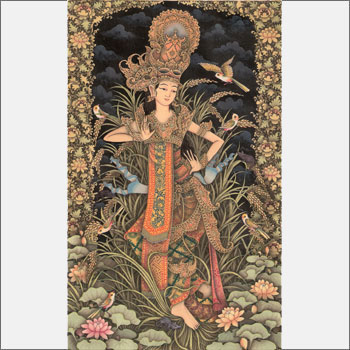
For visitors unfamiliar with the Laksmi bija mantra, let me say a few things about srim — which I can’t properly transliterate here — fyi, it’s pronounced “shreem.” Srim is a seed mantra meaning it contains the full potency of the deity field. In this case, Laksmi, aka the power of splendor, magnificence, expansiveness, abundance… you get the idea.  So the teachings go that whatever Laksmi touches grows into its most magnificent form.  And sweetness is one of the attributes of Laksmi. This is a perfect sweetness. Not so sweet as to be cloying or just plain too sweet. This is the perfection of sweetness. The sweetness that makes us feel, well, let me say it like it is, positively delicious. We might say we experience the sweetness of Laksmi as a kind of effervescent grace. When all is right with our lives and infinity is possible…

Before I go on, let me also say a few things about Monday Night Class. There is much I love about this class. Its longevity. The people who find their way there. The depth and power of the teachings and practice. The sense of welcome, safety, and community. Sometimes though, I think what I love best is the sweetness of the laughter. Here’s a clip from this week’s class:

https://mondaynight.blog/wp-content/uploads/2012/09/9-17-laughter1.mp3

Here’s this week’s dharma talk. Which  begins with the below posted Hafiz. This small group of poems offers an excellent teaching on what gets in the way of our ability/intention to live in and of our sweetness and light [and delight!] I’ll post the Kushner quote which I also read in this talk, below Hafiz. Kushner is writing specifically about Light. The two together make an excellent counterpoint on the topic of sweetness and light. Add in the mantras and we have a fugue for the heart…

Here are the Hafiz poems, from Daniel Landinsky’s book, The Gift. 

THE SAD GAME,

Blame
Keeps the sad game going.
It keeps stealing all your wealth –
Giving it to an imbecile with
No financial skills.
Dear one,
Wise
Up.


TIRED OF SPEAKING SWEETLY

Love wants to reach out and manhandle us,
Break all our teacup talk of God.
If you had the courage and
Could give the Beloved His choice, some nights,
He would just drag you around the room
By your hair,
Ripping from your grip all those toys in the world
That bring you no joy.
Love sometimes gets tired of speaking sweetly
And wants to rip to shreds
All your erroneous notions of truth.
That make you fight within yourself, dear one,
And with others,
Causing the world to weep
On too many fine days.
God wants to manhandle us,
Lock us inside of a tiny room with Himself
And  practice His dropkick.
The Beloved sometimes wants
To do us a great favor:
Hold  us upside down
And shake all the nonsense out.
But when we hear
He is in such a “playful drunken mood”
Most everyone I know
Quickly packs their bags and hightails it
Out of town.


DROPPING KEYS

The small man
Builds cages for everyone
He
Knows.
While the sage,
Who has to duck his head
When the moon is low,
Keeps dropping keys all night long
For the
Beautiful
Rowdy
Prisoners.


FIND A BETTER JOB

Now
That
All your worry
Has proved such an
Unlucrative
Business,
Why
Not
Find a better
Job.


I WISH I COULD SPEAK LIKE MUSIC

I wish I could speak like music.
I wish I could put the swaying splendor
of the fields into words
so that you could hold Truth
Against your body
And dance.
I am trying the best I can
With this crude brush, the tongue,
To cover you with light.
I wish I could speak like divine music.
I want to give you the sublime rhythms
Of this earth and the sky’s limbs
As they joyously spin and surrender,
Surrender
Against God’s luminous breath.
Hafiz wants you to hold me
Against your precious
Body
And dance,
Dance.

Here’s the quote from Lawrence Kushner’s Honey from the Rock:

It is no accident that all the great creation tales begin with light. Of all the things that the Creator might have first formed – mountains, waterfalls, stars, flowers, fruited plains, lions and lambs, leviathans and whirlwinds, single-celled creatures and man – He made light. First of all the Holy One fashioned consciousness.

Let us retell the story of this light which is a metaphor for spiritual awareness:
A light with which the Holy One began the creation. Let there be light and there was light.
In the Zohar we read further of creation. Some kind of dark flame – blinding flash – issued forth from the innermost hiddenness – from the mystery of the Ayn-Sof, the Infinite One….
 
A light that was so dazzling that by it…man could gaze from one end of the universe to the other. A light so powerful that is shattered earthly vessels. A light that if it fell into the hands of the wicked could return creation itself back to primordial chaos. A light that therefore had to be hidden away. And God made a separation.
 
A light that was set aside for the Tsadikim [the righteous ones].
Light is sown for the righteous…
 
A light whose appearance initiates creation. But it is a creation only able to withstand a tiny bit of light. Therefore the light had to be concealed. And so it is that darkness and incompletion and separation are the price of this world. While light initiates existence, existence conceals light.
 
For with the appearance of the light being began,
But with the concealment of the light
all manner of individuated existence was created…
Just this is the mystery of the work of creation;
And one who is able to understand will understand.
 
A light imprisoned in the shards of this created world, waiting for us to free it. Returning itself and us to the Creator.
 
A light so awesome that even a fraction of its splendor – just so much as a ray the thinness of a needle is all any of us need for unimaginable illumination.

Here’s a clip of this week’s chanting. I tried a different microphone placement, hoping to pick up less harmonium, more voices. Alas, I ended up with more harmonium. The call is quite clear, but I’m sorry to say the response is barely audible.

Finally, here’s a clip of the dharana I gave before gliding into silent meditation:

And when the topic is light, the last word goes to Devi, the Shining. This quote is found in the frontpiece of Ajit Mookerjee’s book, Kali, the Feminine Force. He cites Bhairava Yamala as the source text.  I’ve never been able to find this text or any verse resembling the quote. A google search brings up nothing definitive. So I’m going to assume that Mookerjee had access to an unpublished text fragment and made this very beautiful translation. Wherever it comes from, whatever its source, it pulsates with sweetness, luminosity, and supreme bliss:

 She is Light itself and transcendent.

Emanating from Her body are rays in thousands
two thousand, a hundred thousand, tens of millions,
a hundred million
there is no counting their numbers.
 
It is by and through Her that all things moving
and motionless shine.  It is by the light of this
Devi that all things become manifest.    

Monday, September 10, 2012

For the first class of the new fall season, it seemed only right to bask in the luminosity of Gayatri mantra. For readers of this blog who do not attend class, here is the mantra in transliterated Sanskrit:

As I wrote in the previous post, Gayatri mantra is considered the sound form of light.  So Sanskrit, as a language of vibration, is offering us a sonic vessel of  liquid light. Pour it into your bloodstream. Chant it with all your heart. Meaning is secondary, almost irrelevant. Still the mind loves something to dwell on, hence the beautiful imagery of the literal English translation:

Earth. Atmosphere. Heavens.
We meditate on the sacred light of the effulgent source.
Let that light infuse our entire being.

bhur         earth
bhuvah       atmosphere
svaha       heavens
tat          that
savitur      of the source
varenyam     to be held sacred
bhargo       light
devasya      of the effulgent
dhimahi      we meditate on
dhiyo        thoughts, intentions, prayers
yah          which (source)
nah          our
procadayat   should direct, urge, inspire

Here’s a clip of the first round of chanting from this week’s class:

Here’s my dharma talk:

This last clip contains a short dharana to ease into final chanting of the evening: a second round of Gayatri [approximately 26 minutes], followed by Om Namah Shivaya. 

And the final word goes to Rumi. Here’s the text I read at class, from Coleman Barks’ & Michael Green’s, The Illuminated Rumi:

In any gathering, in any
chance meeting
on the street, there is
a shine, an elegance
rising up

Today, I recognized that the jewel-like beauty
is the presence.

Our loving confusion,
the glow in which
watery clay gets
brighter than fire,
the one we call the Friend.

I begged, “Is there a way into you, a ladder?”
“Your head is the ladder, bring it down under your feet.”

The mind, this globe of awareness, is a starry universe that when you push off with your foot, a thousand new roads become clear, as you yourself do at dawn, sailing through the light.

Monday, July 16, 2012

We’re continuing our focus on Patanjali Book III, but adding Laksmi Work to the mix. Something about summer, the abundance of greenery, produce, heat and humidity has me contemplating the force of Laksmi in all its complexity, wonder, and power… Here are the sutras we read this evening:
III,6. Perfect discipline is mastered in stages.
III, 7. These three components – concentration, absorption, and integration – are more interiorized than the preceding five.
III, 8. Even these three are external to integration that bears no seeds.
III, 9. The transformation towards total stillness occurs as new latent impressions fostering cessation arise to prevent
the activation of distractive stored one, and moments of stillness begin to permeate consciousness.
III, 10. These latent impressions help consciousness flow from one tranquil moment to the next.
III, 11. Consciousness is transformed toward integration as distractions dwindle and focus arises.
III, 12. In other words, consciousness is transformed toward focus as continuity develops between arising and
subsiding perceptions.
Readers of this blog who attend class with some regularity, or are conversant with these teachings, will find the above sutras fairly straightforward. If, on the other hand, this language is less than familiar, it may seem undecipherable. So let me say that Patanjali is breaking the movement of mind and breath into carefully delineated categories. And in these sutras, he’s giving us a clue about how to live with an internal sense of freedom and ease. Otherwise known as mastery…
Which is how the Laksmi Work comes into my mind…

I’ll be weaving these two, Patanjali Book III and the Laksmi Work together over the next few weeks. For now I want to get this week’s dharma talk, readings, and chanting clips posted, so will keep this brief.

Here’s a clip of this week’s chanting the yoga sutras:

This is a clip of my dharma talk. It runs long, around 27 minutes.  No big surprise as we read so many sutras this evening. I was particularly focused on III, 8, where Patanjali brings in the notion of seeds of karma. But along with that, this talk, while free-wheeling as my talks often are, begins to tie together threads of Patanjali Book III and the Laksmi Work:
Here are the poems, from Rumi and Mary Oliver, that I read at the close of my talk:
Two from Rumi:

There’s a hidden sweetness
in the stomach’s emptiness.
We are lutes, no more, no less. If the soundbox
is stuffed full of anything, no music.
If the brain and belly are burning clean
with fasting, every moment a new song comes
out of the fire. The fog clears, and a new energy
makes you run up the steps in front of you.
Be emptier and cry like reed instruments cry.
Emptier, write secrets with the reed pen.
When you’re full of food and drink, Satan sits
where your spirit should, an ugly metal statue
in place of the Kaaba. When you fast,
good habits gather like friends who want to help.
Fasting is Solomon’s ring. Don’t give it
to some illusion and lose your power.
But even if you’ve lost all will and control,
they come back when you fast, like soldiers appearing
out of the ground, pennants flying above them.

*********

Submit to a daily practice.
Your loyalty to that
is a ring on the door.
 
Keep knocking, and the joy inside
will eventually open a window
and look out to see who’s there.

This is a clip of chanting the mantra Om Namah Shivaya:
This is a clip of the closing meditation:

Monday, July 9, 2012

This week’s class focused on one sutra. I thought the dawning of wisdom deserved an evening unto itself.

III, 5
Once the perfect discipline of consciousness is mastered,
wisdom dawns.
Just to reiterate, Patanjali’s Book III concerns itself with the final three limbs of classical yoga:  concentration (dharana), meditation/absorption (dhyana) and integration (samadhi). These three limbs form the perfect discipline of consciousness, aka samyama, referred to in the above sutra.
If you imagine the mind/body system as myriad layers of consciousness, some clear, some dense, some hard, some soft, some open, some closed, some sticky, some slippery — you get where I’m going with this — you can see why it’s so hard to get the whole mess integrated. All this to say the practice of samyama  does not come easily. We have to work at it. The mind is a slippery instrument, more often attuned to the kleshas, than its innate wisdom. [Should you want to review the kleshas, go to the May 2011 archive]. Yet wisdom, like the sun, is always blazing. We may be oblivious to its light. That doesn’t mean it’s not here. Which is why taking a moment to turn within can evoke a profound sense of clarity, calm, insight, or wisdom. Of course, Patanjali’s technology for yoking the mind/body system is designed so those moments of clarity, calm, insight, and wisdom stretch into the norm.
This week’s dharma talk attempts to unpack some of the above:
For reasons that will become clear over the next few weeks, I’m feeling a connection between the teachings and practices I’ve come to call the Laksmi Work and our current immersion in Patanjali Book III. More on that as it unfolds. For now, suffice to say we opened class chanting the Laksmi-Murti-Mantra combined with the Dhumavati Bija. I’ll write these mantras out for those unfamiliar with them and also include a clip of the actual chanting:
Here are the mantras:
Here’s an audio clip of the chanting:
Contemplating wisdom inspired me to go down the rabbit hole of parallel teachings:
From the Laksmi Tantra:
I am recognized by the wise as the bliss and tranquility inherent in each state of being. Though that is my true nature, [the individual] does not experience me spontaneously. However, after receiving a mere particle of my anugrahashakti [grace], she discovers me instantaneously…Then after propitiating me by various means [i.e. samyama], the jiva [individual soul] washes away all the kleshas and blows away the dust of impressions; whereby the jiva that has already severed its fetters through meditation, fuses with true knowledge [aka wisdom] and attains me, who am Laksmi and whose nature is supreme bliss.
From the Jneshwari:

 What is action? What is inaction? Thus, even the wise are confused in this matter. This action, I shall explain to you, having known which, you shall be released from evil [i.e. the lack of wisdom].

 One must know the nature of action, the nature of wrong action, and also the nature of inaction. The way of action is profound.

 He who perceives inaction in action, and action is inaction is wise among men; he is is a yogi and performs all actions.

 Such a person seems like other people, but he is not affected by human nature like the sun which cannot be drowned in water.

 He sees the world without seeing it, does everything without doing it, and enjoys all pleasures without being involved in them.

 Though he is seated in one place, he travels everywhere, for even while in the body he has become the universe.

From the Ashtavakra Gita:

1.
The wise man knows the Self,
And he plays the game of life.
 
But the fool lives in the world
Like a beast of burden.
 

2.
The true seeker feels no elation,
Even in that exalted state
Which Indra and all the gods
Unhappily long for.
 

3.
He understands the nature of things.
 
His heart is not smudged
By right or wrong,
As the sky is not smudged by smoke.
 

4.
He is pure of heart,
He knows the whole world is only the Self…
 

5.
Of the four kinds of being…
Only the wise man is strong enough
To give up desire and aversion.

From Lalleshwari , tr. by Coleman Barks

The soul, like the moon,
is new, and always new again.

And I have seen the ocean
continuously creating.

Since I scoured my mind
and my body, I too, Lalla,
am new, each moment, new.

My teacher told me one thing,
Live in the soul.

When that was so,
I began to go naked,
and dance.

Trying to be Thoughtful in the First Brights of Dawn
-Mary Oliver

I am thinking, or trying to think, about all the
imponderables for which we have
no answers, yet endless interest all the
range of our lives, and it’s

 
good for the head no doubt to undertake such
meditation; Mystery, after all,
is God’s other name, and deserves our

 
considerations surely. But, but —
excuse me now, please; it’s morning, heavenly bright,
and my irrepressible heart begs me to hurry on
into the next exquisite moment.

[w/ humble apologies to MO for this blog template’s refusal to format her poem as written…] 

Sunday, July 8, 2012, Part II

Here are notes from July 2, last week’s class. The sutra for the evening was:

III, 4
Concentration, absorption, and integration regarding a single object
compose the perfect discipline of consciousness.
For as long as Monday Night Class has gathered in Princeton, which is well over ten years now, we’ve chanted the mantra Om Namah Shivaya as a vehicle for meditation. In the spirit of this sutra however, I thought it would be interesting to work with the mantra, less as a vehicle, more as that single object Patanjali is referring to. For a group of chanting  bhaktas, this is a more difficult practice. And in that way I think, very fruitful.
Here’s my dharma talk for this class:
 And here are the parallel readings. The first is from Thomas Byrom’s gorgeous translation of the Ashtavakra Gita, a text that pulsates with the life force of samadhi:

Dissolving
 
1
You are pure.
Nothing touches you.
What is there to renounce?
 
Let it all go,
The body and the mind.
 
Let yourself dissolve.
 

2
Like bubbles in the sea,
All the worlds arise in you.
 
Know you are the Self.
Know you are one.
 
Let yourself dissolve.
 

3
You see the world.
But like the snake in the rope,
It is not really there.
 
You are pure.
 
Let yourself dissolve.
 

4
You are one and the same
In joy and sorrow,
Hope and despair,
Life and death.
 
You are already fulfilled.
 
Let yourself dissolve.

And as often happens, I give the final word to Mary Oliver, whose poetry pulsates with the life force of waking up:

The Poet is Told to Fill Up More Pages
Mary Oliver

But, where are the words?
Not in my pocket.
Not in the refrigerator.
Not in my savings account.
So I sit, harassed, with my notebook.
It’s a joke, really, and not a good one.
For fun I try a few commands myself.
I say to the rain, stop raining.
I say to the sun, that isn’t anywhere nearby,
Come back, and come fast.

Nothing happens.
So this is all I can give you,
not being the maker of what I do,
but only the one that holds the pencil.

abcdefghijklmnopqrstuvwxyz
Make of it what you will.

Monday, June 18, 2012


We’re back to Patanjali, making our way through Book 3, The Extraordinary Powers [Vibhuti Pada] of the Yoga-Sutra. This pada concerns itself with the final three limbs of  classical Yoga: concentration [dharana], meditation [dhyana], and integration [samdhi] – and devotes a major portion of the text to the powers [siddhi] that accrue as meditation stabilizes into pure awareness.  While acquiring siddhis is a motivating force for many seekers, the harsh truth is the pursuit of power is a slippery slope. The challenge – what some would call the test – is to touch those siddhis and keep on walking. Although vibhuti is often translated as “extraordinary” or “supernatural powers,” I prefer the literal meaning: “that which extends far.”  More on that in the dharma talk excerpted below.

Here are the sutras we read last week:

III, 1
Concentration locks consciousness on a single area

III, 2
In meditative absorption, the entire perceptual flow is aligned with that object

III, 3
When only the essential nature of the object shines forth, as if formless, integration has arisen.

Here’s an excerpt from my talk:

Here’s a clip of chanting the new sutras:

Here’s the dharana I gave before meditation:

*******

Finally,  here are the Mary Oliver poems I read at class. This first one strikes me as a near perfect articulation of vibhuti….. The second, well read it and see what you think. From where I sit, it’s all about living the non-dual life, what some circles refer to sahaj samadhi, samadhi with open eyes!!!

April

I wanted to speak at length about
the happiness of my body and the
delight of my mind for it was
April, night, a
full moon and —

but something in myself or maybe
from somewhere other said: not too
many words, please, in the
muddy shallows the

frogs are singing.


For Example

Okay, the broken gull let me lift it
from the sand.
Let me fumble it into a box, with the
lid open.
Okay, I put the box into my car and started
up the highway
to the place where sometimes, sometimes not,
such things can be mended.

The gull at first was quiet.
How everything turns out one way or another, I
won’t call it good or bad, just
one way or another.

Then the gull lurched from the box and onto
the back of the front seat and
punched me.
Okay, a little blood slid down.

But we all know, don’t we, how sometimes
things have to feel anger, so as not
to be defeated?

I love this world, even in its hard places.
A bird too must love this world,
even in its hard places.
So, even if the effort may come to nothing,
you have to do something.

It was, generally speaking, a perfectly beautiful
summer morning.
The gull beat the air with its good wing.
I kept my eyes on the road.

Monday, December 5, 2011

We’ve circled back to Patanjali, returning to where we left off during the summer, Book II, 43-45. These sutras elaborate the last three niyamas–which Patanjali classifies as kriya-yoga (aka, the Yoga of Action.) Remember, the niyamas, which we can think of as internal disciplines are considered  the second limb of Yoga. The yamas or external disciplines are the first. Here are the sutras:

[Chip Hartranft’s version]

II, 43
As intense discipline burns up impurities, the body and its senses become supremely purified.
II,  44.
Self-study deepens communion with one’s personal deity.
II, 45
Through orientation toward the ideal of pure awareness, one can achieve integration.

Since many at class asked me to post this talk asap, I’ve done minimal editing. I usually remove extraneous laughter, asides, etc. This clip leaves most of that in. Since the talk was composed of three sections, I’ve divided the clips accordingly.

Here’s the main Dharma Talk on Sutras II 43-45, aka Kriya-Yoga:

Here’s the clip citing Nischala Joy Devi’s translation and connecting of Gayatri Mantra with these three sutras:

The third clip contains quotes I read at the end of my talk.  I’ll post that clip along with the text in a few days.

Finally, here’s a lovely quote to inspire your week…

It is not meaning that we need but sight…    
-Lawrence Durrell

October 31, 2011


Since this week’s class fell on Halloween, I was moved to acknowledge Samhain, the ancient Celtic holiday from which our modern celebration springs.

Here are Samhain blessings I read at class:

May wonder ever illumine your souls as the candle does a room on a long, winter night, may joy blow through your heart with the intensity of the north wind in a blizzard, may peace cover your lives like a blanket of fresh fallen snow.

May you have the hindsight to know where you’ve been, the foresight to know where you are going, and the insight to know when you have gone too far…

May the road rise up to meet you, may the wind be ever at your back. May the sun shine warm upon your face and the rain fall softly on your fields. And until we meet again, may you be held in the hands of Grace.

Harry Potter notwithstanding, Samhain’s special connection to the Dark Goddess has been distorted in our Halloween iconography of witches on broomsticks. It is however, a night to honor the Dark Mother, so I opened class with a medley of Kali chants. Here’s the dharma talk that followed that soaring flight of luminosity…


October 16, 2012

The impulse to chant the Gayatri mantra 2 weeks ago was just that — a strong sense that this was the correct practice for that evening. It was all about infusing ourselves with light as we move into the new fall season. As Gayatri is to Light, Navarna is to Truth. So it seemed only right to add Navarna to the mix. And now, as Navarna is to Truth, Laksmi/Dhumavati-Bija is to infinite possibility. So layering these three mantras over these three weeks strikes me as a triadic blessing invoked during this sacred (which really means powerful) time of year.

This week’s Chant: The Sublime Laksmi Murti & Dhumavati Bija mantras.

Here’s this week’s dharma talk, inspired by the Tarika-Dhumavati bija mantras. It also touches on the Mangalam and quotes these lines from the Katha Upanishad…

Beyond the senses are the objects,
Beyond the objects is the mind,
Beyond the mind, the intellect,
Beyond the intellect, the ātman,
Beyond the ātman, the non-manifest,
Beyond the non-manifest, the spirit,
Beyond the spirit, there is nothing.
This is the end, pure awareness.

The Mangalam Chant

For those who’ve been asking for a recording of the Mangalam, here it is, along with words to the chant and translation/commentary. So many people ask about developing a daily inner work practice. This is a beautiful chant to include. What better way to start (or end) your day than naming and blessing each and every aspect of creation!

Bhumi-Mangalam,  Udaka-Mangalam,  Agni-Mangalam, Vayu-Mangalam,  Gagana-Mangalam,  Surya-Mangalam,
Chandra-Mangalam,  Jagat-Mangalam,  Jiva-Mangalam, Deha-Mangalam,  Mano-Mangalam, Atma-Mangalam,
Sarva-Mangalam-Bhavatu-Bhavatu-Bhavtu…

May there be peace in earth, water, fire, and air, the sun, moon, and planet, in all living beings, in body, mind and heart. May that peace be everywhere and in everyone.

Mangala is an adjective meaning auspicious, lucky, fortunate, etc. With the suffix “m,” it becomes a noun: auspiciousness, luck, etc. It is also related to the goddess Durga suggesting, “one whose touch brings ecstasy.”