MARCH 6, 2017, BHAGAVAD GITA TALK #5: WHEN A MAN GIVES UP ALL DESIRES THAT EMERGE FROM THE MIND, AND RESTS CONTENTED IN THE SELF, BY THE SELF, HE IS CALLED A MAN OF FIRM WISDOM. [2.55]
It’s been a dizzying week in the Age of Trump. Kushner up, Bannon down. Gorsuch in, filibuster out. Nunes falls, Conaway rises. Not to mention North Korea, China, Syria, and Russia. I started writing this post last night, concerned that with Trump’s approval numbers plummeting, he’d be looking for a war. But I never thought he’d move so quickly. I tend to keep a pretty cool head, but honestly, when I saw the news last night my heart stood still. I have not agreed with American policy regarding the nightmare in Syria, but starting World War III is not the solution…
Which brings me back to the Bhagavad Gita’s teachings around stitha prajna, what I’ve always referred to as “steady wisdom.” Mitchell translates stitha prajna as “firm wisdom” and since we’re using his translation, I’ll defer to that language. First though, let’s have a look at the Gita’s succinct definition of what firm wisdom is not:
If a man keeps dwelling on sense-objects, attachment to them arises; from attachment, desire flares up; from desire, anger is born; from anger, confusion follows; from confusion, weakness of memory; weak memory—weak understanding; weak understanding—ruin. [2.62-63]
Needless to say, this pathology is perfectly embodied in Trump and his administration. And what can we do in the presence of rampant delusion and cruelty but keep pushing back. Arm ourselves with stitha prajna and as Krishna instructs Arjuna at the beginning of the Gita, stand up and fight…
When a man gives up all desires that emerge from the mind, and rests contented in the Self by the Self, he is called a man of firm wisdom. [2.55]
Though the unwise cling to their actions, watching for results, the wise are free of attachments and act for the well-being of the whole world. [3.25]
Cultivating stitha prajna is the work of a lifetime. And it certainly requires focused committed inner work alongside focused committed outer work. But every time we push deeper inside ourselves, unravelling the knots of psycho/emotional wounding and clearing the debris of the past, we create more space for our innate stitha prajna, our steady wisdom, to breathe. And that is a great and noble weapon. Every exhalation sends a flare of sanity into the world.
As I marvel at the scandals, ethics violations, incompetence and subterfuge dominating the first 100 days of the Trump presidency, I keep thinking of the stories of the Mahabharata that form the backdrop of the Bhagavad Gita. There we have a horrendous war between two dynasties with a tangled web of betrayals. Betrayals that include really bad treatment of women, cheating, jealousy, revenge, and backroom deals. By the end of the war, both sides have been decimated. Sound familiar. I could be writing about our current political landscape.
And in the midst of the Mahabharata, right there on the battlefield of a war to end all wars, comes the Bhagavad Gita. It’s astonishing really when you think about it. Before the first arrow has been loosed, we’re given a complete exposition of the yogic path, shown step by step how we become truly human.
Coming as it does at this moment in the epic gives even more potency to the possibility inherent in the teaching. That even in the midst of greed-driven madness, we can hold onto ourselves, retain our equanimity, and stand up for dharma. In fact, we must. And to those who distort the meaning of the Gita, seeing it as a handbook for domination and war, I think this single verse sets that record straight:
Though the unwise cling to their actions, watching for results, the wise are free of attachments, and act for the well-being of the whole world. [3.25]
If you ever need a standard for right action, there it is. “The wise are free of attachments and act for the well-being of the whole world.”
Since I’ve been unable to keep this blog current, I’m doubling up audio and poems from the last two February classes. I’ll try to get all of March up in the next week…
FEBRUARY 13, 2017, BHAGAVAD GITA TALK#3: “THE WISE MAN WHOSE INSIGHT IS FIRM, RELINQUISHING THE FRUITS OF ACTION, IS FREED FROM THE BONDAGE OF REBIRTH AND ATTAINS THE PLACE BEYOND SORROW.”
1. I don’t know what sort of God we have been talking about.
The caller calls in a loud voice to the Holy One at dusk.
Why? Surely the Holy One is not deaf. He hears the delicate anklets that ring on the feet of an insect as it walks.
Go over and over your beads, paint weird designs on your forehead, wear your hair matted, long, and ostentatious, but when deep inside you there is a loaded gun, how can you have God.
2. Friend, please tell me what I can do about this world I hold to, and keep spinning out! I gave up sewn clothes, and wore a robe, but I noticed one day the cloth was well woven.
So I bought some burlap, but I still throw it elegantly over my left shoulder.
I pulled back my sexual longings, and now I discover that I’m angry a lot.
I gave up rage, and now I notice that I am greedy all day.
I worked hard at dissolving the greed, and now I am proud of myself.
When the mind wants to break its link with the world it still holds on to one thing.
Kabir says: Listen my friend, there are very few that find the path!
3. The spiritual athlete often changes the color of his clothes, and his mind remains gray and loveless.
He sits inside a shrine room all day, so that the Guest has to go outdoors and praise the rocks.
Or he drills holes in his ears, his hair grows enormous and matted, people mistake him for a goat… He goes out into wilderness areas, strangles his impulses, and makes himself neither male nor female…
He shaves his skull, puts his robe in an orange vat, reads the Bhagavad-Gita, and becomes a terrific talker.
Kabir says: Actually you are going in a hearse to the country of death, bound hand and foot!
FEBRUARY 27, 2017, BHAGAVAD GITA TALK #4: THE MIND IS A MASTER AT BURNING US OUT… “WHEN A MAN GIVES UP ALL DESIRES THAT EMERGE FROM THE MIND, AND RESTS CONTENTED IN THE SELF BY THE SELF, HE IS CALLED A MAN OF FIRM WISDOM.”
Alongside the Gita verses, I re-read one of last week’s Kabir poems and one other from his canon and one from Mary Oliver’s House of Light.
Here’s the Kabir:
I said to the wanting-creature inside me: What is this river you want to cross? There are no travelers on the river-road, and no road. Do you see anyone moving about on that bank, or resting? There is no river at all, and no boat, and no boatman. There is no towrope either, and no one to pull it. There is no ground, no sky, no time, no bank, no ford!
And there is no body, and no mind! Do you believe there is some place that will make the soul less thirsty? In that great absence you will find nothing.
Be strong then, and enter into your own body; there you have a solid place for your feet. Think about it carefully! Don’t go off somewhere else! Kabir says this: just throw away all thoughts of imaginary things, and stand firm in that which you are.
And here’s the Mary Oliver:
Five A.M. in the Pinewoods
I’d seen their hoof prints in the deep needles and knew they ended the long night
under the pines, walking like two mute and beautiful women toward the deeper woods, so I
got up in the dark and went there. They came slowly down the hill and looked at me sitting under
the blue trees, shyly they stepped closer and stared from under their thick lashes and even
nibbled some damp tassels of weeds. This is not a poem about a dream, though it could be.
This is a poem about the world that is ours, or could be. Finally one of them — I swear it! —
would have come to my arms. But the other stamped sharp hoof in the pine needles like
the tap of sanity, and they went off together through the trees. When I woke I was alone,
I was thinking: so this is how you swim inward, so this is how you flow outward, so this is how you pray.
JANUARY 30, 2017: BHAGAVAD GITA TALK #1. “ON THIS PATH NO EFFORT IS WASTED”
In the weeks between the November election and January inauguration, the great majority of us on the other side of madness were in shock, beginning to mobilize, but also holding out hope that somehow, some way, this political nightmare would be averted. Time seemed to stand still, and then, it was done. We found ourselves waking up in a whole new reality, waking up in an America we did not recognize, waking up in the age of Trump.
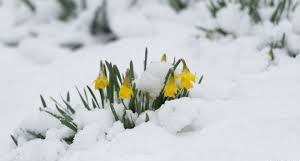
And now it’s March. In just six days it will be Spring. Although here on the East coast we’re being slammed by winter weather we barely had all winter. Last week, sixty degrees and daffodils blooming. Today they’re buried under the snow. The sweet promise of new life and renewal postponed for the time being.
Which brings me to the Bhagavad Gita. When I was younger in my journey, I devoured texts like this one.I couldn’t get enough. These last years though I’ve mostly stayed away from them. Partly it’s the patriarchal language, partly what sometimes seems a jungle of verbiage. At this stage of my life, I way prefer the naked simplicity of Mary Oliver’s poetry and Robert Bly’s Kabir.
And yet, the Bhagavad Gita is a powerful compendium of the yogic system. And has a great deal to say about waking up, about the difference between authentic power and something that pretends to be. About true greatness of soul and that empty charade that is grandiosity and smallness. Like so many of India’s ancient wisdom texts, no one knows for sure when this one was written. Scholars date it sometime between the fifth century B.C.E and first century C.E.The wonder of it is, it’s incredibly relevant for now.
Because along with articulating the philosophy and psychology of Yoga, the Gita offers a rather precise technology for strengthening ourselves from the inside out, so we can not only meet, but act effectively, to counter the dangers of this time. There is so much work to do. So many moving parts. So many different voices and needs to attend to. It’s easy to lose focus, burn out, numb out, and feel overwhelmed. Working with the Gita offers a steadying, sobering, and heart-drenched medicine for standing strong in the face of that and those who dare to cause harm…
The edition we’re using is Stephen Mitchell’s Bhagavad Gita: A New Translation. My scholar friends will thumb their noses, but I do like his version. Perhaps it’s Mitchell’s long training in Zen. True to the text and written with great respect and reverence, there’s a spareness in his writing I respond to. The Introduction alone is superb. Mitchell really gets it! Here’s how he opens:
One of the best ways of entering the Bhagavad Gita is through the enthusiasm of Emerson and Thoreau, our first two America sages. Emerson mentions the Gita often in his Journals, with the greatest respect…
It was the first of books; it was as if an empire spake to us, nothing small or unworthy but large, serene, consistent, the voice of an old intelligence which in another age and climate had pondered and thus disposed of the same questions which exercise us.
What a revelation the Gita must have been for minds predisposed to its largehearted vision of the world. And what a delight to stand behind Emerson and Thoreau, reading over their shoulders as they discover this “stupendous and cosmogonal” poem in which, from the other side of the globe, across so many centuries, they can hear the voice of the absolutely genuine. Here is a kinsman, an elder brother, telling them truths that they already, though imperfectly, know, truths that are vital to them and to us all. In the Gita’s wisdom, as in an ancient, clear mirror, they find that they can recognize themselves….
And here’s how he closes:
The healthiest way to begin reading and absorbing a text like the Bhagavad Gita is to understand that ultimately it has nothing to teach. Everything essential that it points to—what we call wisdom or radiance or peace—is already present inside us. Once we have practiced meditation sincerely and seen layer after layer of the inauthentic fall away, we come to a place where dualities such as sacred and profane, spiritual and unspiritual fall away.
Zen Master Hsueh-feng asked a monk where he had come from.The monk said, “From the Monastery of Spiritual Light.”
The Master said, “In the daytime, we have sunlight, in the evening, we have lamplight. What is spiritual light?”
The monk couldn’t answer.
The Master said, “Sunlight. Lamplight.”
In that place, God is the ground we walk on, the food we eat, and the gratitude we express, to no one in particular, as naturally as breathing.
* * * * *
How’s that for a beautiful (and over the top tantric) definition of God.
Here’s the audio of my first Dharma Talk on the Gita. This is from January 30, 2017. I also want to add that for no rational reason I can articulate, but from the shakti that informs my work, the mantras we’ve been chanting this cycle are Om Tara Tuttare Ture Swaha and Namo Kuan Shih Yin P’u-Sa. This talk opens with a just shy of 3-minute explication of the Tara mantra.
A beautiful day in Princeton. Walking over to vote this morning, I felt such a sense of the importance of this small act of civic responsibility. Which, politically cynical as I’ve grown over the years, surprised me. And then, even more surprising, the thrill I felt as I cast my vote. But what surprised me most of all were the tears that welled up as I walked out of my polling place.
So much divides us. The country seems as polarized as it was during the Civil War. One wonders where we go from here. How does Hillary (and I trust she will win this election) begin to heal the gulf. How do any of us reach out to the other side. These are the big questions. And if neuropolitical research is correct, our political stance is predetermined in our hard wiring.
Listening helps. Standing less on the side of being right, more on the side of being open helps. These are skills we can develop as long as we’re willing to step outside our own definitions of what is right, and feel the fear or pain or hatred of another. Is my fear of Donald Trump any different than a Trump supporter’s fear of Hillary Clinton. Same fear. Just pointed in a different direction.
At class last night I read from Baba Muktananda’s 1981 book, Where Are You Going? As relevant today as it was 35 years ago.
Today the world is said to be making more and progress, but in what way has it become greater… All over the world there is hatred among nations, hostility among political parties, animosity among societies, and enmity among races and classes. People talk about innovation and reform, but in the name of these things they have succeeded only in destroying the environment, in wrecking family life, and increasing selfishness and hostility.
In such a world there is only one thing we need, and that is the true understanding of humanity. Yet that is exactly what we lack. Why does a human being behave as he does? Why does he create barriers between himself and others? He does these things because he lacks true understanding about himself. He does not know the greatness that lies within the human heart. Yet if he were to look within himself, he would realize that he contains the divinity of the entire world.
Perhaps, in the end, it all comes down to Love. The kind of love that stretches across the boundaries and holds us strong in its embrace. The love that’s called agape or maitri. It’s what I touched this morning when those tears welled up. Last thing I ever expected to happen. Yet there it was, shimmering inside of me, waiting for me to open up and feel its grace.
I read this beautiful poem by Marie Howe at class last night. It’s deep. if you don’t already know it, read it out loud several times at least and it will come alive for you…
Annunciation
Even if I don’t see it again — nor ever feel it I know it is — and that if once it hailed me it ever does–
and so it is myself I want to turn in that direction not as toward a place, but it was a tilting within myself,
as one turns a mirror to flash the light to where it isn’t — I was blinded like that — and swam in what shone at me
only able to endure it by being no one and so specifically myself I thought I’d die from being loved like that.
I cannot believe it is already November. And thank goddess the presidential campaign is over tomorrow.Or let us hope it ends tomorrow with no re-count challenges…
At class last week, we were contemplating the five koshas as described in the Taittiriya Upanishad. A fancy way to articulate the various levels (aka bodies) that weave through the ultimate oneness of our human being-ness. The more I think about it, the more I think that while this way of breaking it down into categories has its place in the work of developing mastery, I do believe Mary Oliver says it all way more beautifully….
WHAT CAN I SAY -Mary Oliver
What can I say that I have not said before? So I’ll say it again. The leaf has a song in it. Stone is the face of patience. Inside the river there is an unfinishable story and you are somewhere in it and it will never end until all ends.
Take your busy heart to the art museum and the chamber of commerce but take it also to the forest. The song you heard singing in the leaf when you were a child is singing still. I am of years lived, so far, seventy-four, and the leaf is singing still.
When I was meditating this morning, I found my mind contemplating the question, “Why?” Why do I meditate? Why have I been doing this practice now for nearly forty years? What have I received? Have I done it to receive anything? What’s the bloody point of it all? Why do I teach it to others?
And I remembered, being in high school, maybe my junior year. 1964 or 1965. I was reading Herman Hesse’s Siddhartha. I can still feel myself lying on the living room couch in my family’s home absorbed in that narrow paperback. And I came to the end of the story, where he has attained something wonderful. He has attained stillness. And every cell in my being started to pulsate. I didn’t know how to find what he found, but in that moment, my quest began…
So why do I meditate? All those years in Siddha Yoga formed a habit. What began as a quest and became a rigid following of ashram discipline — (really rather fear-based if I speak the truth to you now) — just became something I do.
Like breathing. Or sleeping. Or drinking chai.
And at this point in my life, to borrow a phrase from Mary Oliver, I am of years lived, so far, sixty-eight… And find I don’t need a reason. In fact, I question if having a reason is actually counter to the practice.
Meditating may contribute to my health and vitality —
may help to anchor my insight and intuition —
may foster an inner glow —
but I realized this morning that I don’t do it for any of those reasons.
I just meditate to meditate.
If I have a reason, it’s something like for the sheer joy of being alive and experiencing the sometimes beautiful, sometimes terrible, sometimes wonder-filled, sometimes terrifying life/death dance of life.
Which is more than enough reason for me.
* * * *
Tomorrow is Election Day in the USA. If you’re a US citizen, please vote!!! Because even though it seems like it barely makes a difference. That the status quo remains the status quo. That our so-called leaders remain in the pockets of corporate lobbyists. Still, somehow, in the big picture, it does matter. If only to elect someone who understands the climate crisis is here and it is real. And that is Hillary Clinton. Whether she’ll be able to do anything about it, probably only those incremental steps she’s famous for. And whether incremental steps are enough… I don’t think so. Nevertheless, I’m voting for Hillary. Not because she’s inspired me as a candidate. (She has not.) Not because she’s a woman. (To me it’s less about gender and more about consciousness.) Not because I particularly want to see Bill Clinton back in the White House. (It actually kind of creeps me out.) I’m voting for Hillary Clinton because I think she is far and away the best choice we have. And while I don’t agree with all her policies. And have concerns about how enmeshed she is in politics as usual. Still, I have real respect for her intelligence, wonkiness, and discipline. And suspect that although she doesn’t often show it in her public persona, I think she actually cares. And while I don’t think that’s enough. I do think it’s a starting point. We just need to ensure she is elected. And then keep pushing her to govern from that sense of care. Not from fear. Not from greed. Not from a need to dominate. To govern with care for everything that lives and breathes and is of this Earth we all call home…
I think a lot about listening. What it means to really listen to oneself. What it means to listen to another. What is means to listen to the world. How do we cultivate ears that truly hear. How do we foster a communication between ourselves and everything of our world that makes communion happen. So much gets in the way of that. So much mucks up the clear space within and around us. So that rather than communion, we often end up with separation. We cling to our belief systems. We cling to our stories. We cling to our idea of being right. Which doesn’t let in much space for listening. We’re too busy telling…
Here’s a talk about listening that weaves in yogic teachings on the mind, aka, the Four-Part Psychic Instrument or antahkarana. Like so much passed down through the Hindu Yogic system, this perspective on the mind is quite simple and profound. I unpack it in the talk, but here are the technical terms spelled out.
The four levels of antahkarana or the Four-Part Psychic Instrument
Manas: often translated as mind-stuff. From our western perspective, think of it as your conscious mind.
Chitta: translated in a myriad of ways. From our western perspective, think of it as the unconscious.
Ahamhara: in the yogic system, this is the sense of “I.” Often referred to as the ego.
Buddhi: the discriminating faculty.
Here’s the talk:
And here is a wonderful poem from Mary Oliver who is perhaps one of the greatest listeners we have.
The Fist Mary Oliver
There are days
when the sun goes down
like a fist,
though of course
if you see anything
in the heavens
in this way
you had better get
your eyes checked
or, better still,
your diminished spirit.
The heavens
have no fist,
or wouldn’t they have been
shaking it
for a thousand years now,
and even
longer than that,
at the dull, brutish
ways of mankind—
heaven’s own
creation?
Instead: such patience!
Such willingness
to let us continue!
To hear
little by little,
the voices—
only, so far, in
pockets of the world—
suggesting
the possibilities
of peace?
Keep looking.
Behold, how the fist opens
with invitation.
This week’s class fell on 6/06/16 which got me thinking about the significance of the number six. If you stop think about it, the number six is composed of 2 3’s and/or 3 2’s. The 2’s represent opposite poles and the movement towards balance. The 3’s represent a unifying synthesis, the sacred trinity we find in so many traditions. When you put that all together, you can see why you end up with a number that is connected to the exuberant amazing glorious expressive, and most of all life-giving Sun…
Here’s a quote from Vicki Noble’s Motherpeace Tarot:
Sixes: Exuberance
The Sixes are full and expressive, a peak number, always expansive and positive in some way. Six represents exuberance or triumph, being on top of things. Like the Sun sitting at the center of the solar system, Six sits at the center of the Kabalistic Tree of Life and radiates out in every direction, saying, “yes!” Six represents a moment of decisive action or a climax of some sort, a moment of glory.
Which all seemed an excellent jumping off point for a class that constellated around the fifth Sun mantra, the creation story of Ganesha, and the inner possibility of soaring…
ॐ खगाय नमः
om khagāya namaḥ |
Salutations to Khaga, who travels the sky like a bird…
I love all the Sun mantras, but this is one that always jumps out at me. I love the image of light traveling through the sky like a bird. I also love the way “light” as in light and “light” as in lightness are so connected. Which gets me thinking about the incredible lightness of being we feel in the presence of people who are, well, full of light. People who have a buoyancy of spirit and soul that soars like a bird. And what a delight (there’s that word again) to have them in our lives. Because let’s face it. Most of us lean towards the heaviness of being. We are gravity-based creatures. And that’s not just the gravity of Earth. There’s a potent gravitational force in the demands of daily life, in the stress we hold in our bodies, in the narratives and belief systems that can (and often do) keep us down. Although we don’t like to admit it, many of us prefer to be stressed out. It’s familiar, provides solid reasons for everything that’s not working in our lives, and most of all, distracts us from remembering we are finite being living in an unfathomable mystery we will never be able to control. The irony being that the Mystery does seem to be made of light…
Here’s my opening dharana on the mantra Om Namaha Shivaya as a bird with two wings:
And here is this week’s dharma talk, a weaving of the well-known creation story of Ganesha from the Shiva Purana with 5th Sun mantra. I’m interested in what it takes to foster the incredible lightness of being embodied in Ganesha and articulated in this mantra. One point I didn’t get into in this talk is looking at Ganesha as a threshold keeper. If you look at the two common epithets assigned to “him,” Lord of Beginnings and Gatekeeper of the Sacred Feminine, you can see what I’m talking about. But what does that really mean, to be a threshold keeper. Ganesha resides in the space between, embodying a perfect balance, a lightness of being that makes it possible to ride on the back of mouse without crushing it. In my opinion, this is the reason for spiritual practice. So that we can walk lightly on the Earth, lightly through ups and downs of daily life, and perhaps most important since it makes these first two possible, walk lightly within ourselves…
The Glow of Your Presence Hafiz [English version by David and Sabrineh Fideler]
Where have you taken your sweet song?
Come back and play me a tune.
I never really cared for the things of this world.
It was the glow of your presence
that filled it with beauty.
The literal translation of the fourth Sun mantra, ॐ भानवे नमः om bhānave namaḥ is “Salutations to Bhānu, the bright splendor of light.” I’ve also seen it translated as “the diffuser of light.” Thinking about this week’s class, I was intrigued by the notion of diffusing, less as an aspect of the Sun — more in the way the mind diffuses light. Specifically that innate light otherwise knows as the inner Self. Which is the light that actually illuminates the mind so we’re even aware we’re thinking, let alone having peak experience enlightening flashes of insight.
When the mind is crystal clear, this inner light diffuses in its bright splendor aspect. When it’s not, the light diffusing through the mind’s lens (or lenses), will be distorted. Sometimes just a bit. Sometimes so much that it’s obliterated in the opacity.
Which brings me to the kleshas, those lovely lenses so brilliantly articulated in the great text of yogic psychology, Patanjali’s Yoga-Sutra. If you’re new to this blog and/or unfamiliar with this text, do visit May 15, 2011 in the Archive. For a quick reference, here you go:
The Kleshas
Avidya is the lens that clouds our ability to know our true nature, which according to Yoga is light.
Asmita is the lens that tricks us into buying into that small sense of self that is prone to suffering.
Raga is pleasure, which, when tangled up with avidya and asmita, gets us all caught up in clinging to what makes us feel good.
Dvesha is aversion, which when tangled up with avidya and asmita, creates a profound separation from everything and anything we label as “bad.”
Abinivesha is clinging to life (or any situation) because we fear death (or change).
Needless to say, the mind is a complex instrument, managing any number of receiving, perceiving, discerning, projecting, remembering, associating, etc. functions at the same time. And the kleshas are right in there, wreaking havoc in the process. So this week’s talk explores the relationship between the kleshas and this fourth Sun mantra.
Here’s the opening dharana:
Here’s my dharma talk:
There were new people in the room this week so I spoke a bit about mantra. Here is that clip:
Finally, here are this week’s readings. First two poem from Coleman Bark’s translation of the poetry of Lalleshwari, Naked Song. Although Lalla would not have known the Yoga-Sutra, you can see how in both these poems, she is teaching about the kleshas.
Two From Lalleshwari
1. Wear just enough clothes to keep warm. Eat only enough to stop the hunger-pang.
And as for your mind, let it work to recognize who you are, and the Absolute, and that this body will become food for the forest crows.
2. Enlighten your desires. Meditate on who you are. Quit imagining.
What you want is profoundly expensive, and difficult to find, yet closeby.
Don’t search for it. It is nothing, and a nothing within nothing.
And a Sheikh Nasrudin story and commentary from Swami Muktananda’s, Where Are You Going? A Guide to the Spiritual Journey:
Once Sheikh Nasrudin woke up early in the morning, before it was light. He called his disciplele, Mahmud, and said, “Go outside and see if the sun has risen.” Mahmud went out and came back inside.
“It’s pitch black,” he said. “I cannot see the sun at all.”
At this, Nasrudin became very angry. “You fool,” he shouted. “Haven’t you got the sense to use a flashlight?”
That is exactly what we do. To expect a spiritual technique to reveal the indwelling God is like expecting a flashlight to illumine the Sun. A flashlight cannot shine beside the Sun. Like the Sun, the Self is always shining with its own effulgence. What sadhana can illumine the Self. Only through a subtle and sublime intellect can we know it. We meditate and perform spiritual practices only in order to make the intellect pure enough to reflect the effulgence of the Self.
Baba did teach a great deal from Patanjali and in this quote, although he’s not using technical language, he is very much speaking about spiritual practice as a way to clean and polish the mind (here referred to as intellect) so that nothing hinders, obstructs, distorts, or extinguishes the shining bright splendor of the Self.
The last time I checked in here, it was November and I was settling into my new home. What I’d not yet begun to write about was my discovery and subsequent love affair with the Surya Namaskar mantras. These mantras came to me in April 2015 and after a few weeks of singing them, it was clear they were the centerpiece of our next album in The Mantra Project collection. That album, Mantras of the Sun, released April 22, 2016 and debuted at #2 on iTunes World Music Chart. I’m developing a new blog devoted solely to these mantras and my own contemplations of the Sun. More on that when it goes live. In the meantime, if you’d like to listen or buy it, it’s available wherever music is streamed and/or sold. And if you have any problems finding it online, please visit my website, suzingreen.com.
The Sun mantras are elemental mantras, embodying twelve aspects of the Sun. For me personally, working with them has been an ongoing revelation. Early on in the process, I realized how much I’ve taken this extraordinary star that just happens to be our Sun, for granted. It is after all the source and sustainer of life on Earth, always there even when we don’t see it. The absolute center of our solar system, it’s way more than a metaphor or archetype. It’s a fully embodied form and rather amazing mirror of our own inner light.
For those who visit this blog who don’t attend class or have not been to Mantras of the Sun concerts, I’ll include the mantras at the end of this post.
We’ve now had many classes constellated around these mantras. Over the coming months, as I’m able to blog here, I’ll post more content from this last year of Monday Night Class. Rather than go back to the beginning however, I’m posting material from this week, Monday, May 16, 2016. The contemplation for this class was “Generosity” and the mantra we focused on was:
om sūryāya namaḥ |
Salutations to Sūrya, the self-luminous light
Here’s the opening dharana:
As I wrote above, the topic for class this week was “Generosity.” And if you think about the Sun, I think you’ll agree, among its many aspects, generosity is a key one. The Sun shines down on this entire planet, offering its life giving energy in the forms of light and heat and asking nothing, NOTHING, in return. You want a role model for right living, perhaps I should call it “light living,” make friends with the Sun.
Here’s my dharma talk from May 16:
[audio
Here are the poems and the story:
Making the House Ready for the Lord
Mary Oliver
Dear Lord, I have swept and I have washed but still nothing is as shining as it should be for you. Under the sink, for example, is an uproar of mice – it is the season of their many children. What shall I do? And under the eaves and through the walls the squirrels have gnawed their ragged entrances – but it is the season when they need shelter, so what shall I do? And the raccoon limps into the kitchen and opens the cupboard while the dog snores, the cat hugs the pillow; what shall I do? Beautiful is the new snow falling in the yard and the fox who is staring boldly up the path, to the door. And still I believe you will come, Lord: you will, when I speak to the fox, the sparrow, the lost dog, the shivering sea-goose, know that really I am speaking to you whenever I say, as I do all morning and afternoon: Come in, Come in.
The Place I Want to Get Back To
Mary Oliver
is where in the pinewoods in the moments between the darkness and first light two deer came walking down the hill and when they saw me they said to each other, okay, this one is okay, let’s see who she is and why she is sitting on the ground, like that, so quiet, as if asleep, or in a dream, but, anyway, harmless; and so they came on their slender legs and gazed upon me not unlike the way I go out to the dunes and look and look and look into the faces of the flowers; and then one of them leaned forward and nuzzled my hand, and what can my life bring to me that could exceed that brief moment? For twenty years I have gone every day to the same woods, not waiting, exactly, just lingering. Such gifts, bestowed, can’t be repeated. If you want to talk about this come to visit. I live in the house near the corner, which I have named Gratitude.
This post is already so long I’lll end with the mantras and include the Jataka Tale I told on my next post. Here are the mantras.
THE TWELVE SŪRYA NAMASKAR MANTRAS
ॐ मित्राय नमः
om mitrāya namaḥ |
Salutations to Mitra, the friend of all
ॐ रवये नमः
om ravaye namaḥ |
Salutations to Ravi, whose radiance hums
ॐ सूर्याय नमः
om sūryāya namaḥ |
Salutations to Sūrya, the self-luminous light
ॐ भानवे नमः
om bhānave namaḥ |
Salutations to Bhānu, the bright splendor of light
ॐ खगाय नमः
om khagāya namaḥ |
Salutations to Khaga, who moves through the sky like a bird
ॐ पूष्णे नमः
om pūṣṇe namaḥ |
Salutations to Puṣan, whose cleansing light gives strength
ॐ हिरण्यगर्भाय नमः
om hiraṇyagarbhāya namaḥ |
Salutations to Hiraṇyagarbha, the golden egg resplendent as the sun
ॐ मरीचये नमः
om marīcaye namaḥ |
Salutations to Marīci, the shining particle of light
ॐ आदित्याय नमः
om ādityāya namaḥ
Salutations to Āditya, the son of Aditi, the mother of the gods
ॐ सवित्रे नमः
om savitre namaḥ |
Salutations to Savitṛ, the vivifying power of the sun
ॐ अर्काय नमः
om arkāya namaḥ |
Salutations to Arka, whose flash of light is a song upon the earth
ॐ भास्कराय नमः
om bhāskarāya namaḥ |
Salutations to Bhāskara, the beautiful splendor of light
Had someone had told me in early June, that by September I’d have sold my house and moved to an in-town apartment, I would have said, “No way.” Yet here I sit, marveling at the change that brought me here and reveling in the perfection of the timing and lightening of my load.
One of the many wonders of this stunningly unanticipated shift has been watching my cat Lily adjust to her new home. Lily is ten years old and a creature of profound and sedentary habit. In the language of Yoga we would say she is kapha on steroids, tamasic to the nth degree. I knew the change would be traumatic for her, but was unprepared for the extent. She spent her first three weeks here hiding under my bed. By the end of the first month, she was slowly emerging. By week six, she’d finally found her groove.
That’s when I noticed the transformation. And transformation is not a word I associate with cats. Nevertheless, as Lily embraced her new surroundings, she regained that marvelous feline curiosity and a new bounce in her gait. Her eyes looked brighter. Her coat had more shine. Her sedentary habits had slipped away.
Watching Lily’s transformation was such a confirmation of the yogic impulse to push through limitation. All those narratives, conscious and hidden, that diminish our sense of Self. Physical pain, fears, belief systems, psycho/emotional wounding, habitual patterns, the list of stifling possibilities goes on and on. And as we’ve all experienced so many times, every time we push through these holding patterns, we get bigger. We taste our infinite possibility. We become more of who we actually are. I’ve always known this is true of humans. I had no idea it is also true of cats…
While these individual acts of reclamation may not be enough to transform the toxic narratives that threaten our 21st century world, I think each one adds a drop to the ocean of wisdom, the ocean of light. And one of these days or years or eons from now, that ocean will devour the terrible darkness that knows only how to cause harm.
For now, we can only do what we can do. Some are called to the front lines. Others work in the unseen corners. But wherever we may be, we can always shift out of stuck patterns. Any small act will do. It can be as simple as saying “yes” if our default is “no,” or “no,” if our default is “yes.” The key is in pushing through our comfort zones. Be they physical, intellectual, emotional, or spiritual. We’ve all had the experience ten thousand times. Every time we move past those self-imposed fences, something wonderful opens up inside.
I recently fell in love with a new poem from Mary Oliver. She sings this truth so beautifully. If you receive my eNewsletters, you have it in the Thanksgiving blast. If you do not, enjoy…..
Storage
Mary Oliver
When I moved from one house to another there were many things I had no room for. What does one do? I rented a storage space. And filled it. Years passed. Occasionally I went there and looked in, but nothing happened, not a single twinge of the heart. As I grew older the things I cared about grew fewer, but were more important. So one day I undid the lock and called the trash man. He took everything. I felt like the little donkey when his burden is finally lifted. Things! Burn them, burn them! Make a beautiful fire! More room in your heart for love, for the trees! For the birds who own nothing–the reason they can fly.
from Felicity, Penguin Books, 2015. Click here to order a copy.


 A beautiful day in Princeton. Walking over to vote this morning, I felt such a sense of the importance of this small act of civic responsibility. Which, politically cynical as I’ve grown over the years, surprised me. And then, even more surprising, the thrill I felt as I cast my vote. But what surprised me most of all were the tears that welled up as I walked out of my polling place.


 The Monday Night Blog