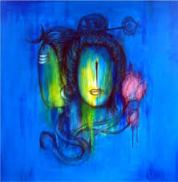
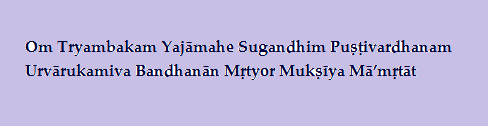
Over the next several weeks, we’ll be immersing ourselves in Maha Mrtunjaya, the go-to mantra for healing and longevity. For Monday Night Blog visitors unfamiliar with this mantra, Maha Mrtunjaya is a vedic chant addressed to Lord Shiva as Tryambaka, the “Three-Eyed One.” So for starters, understand that this mantra works with the third eye, opening a portal so the blaze of inner luminosity can cut through all the layers of stuff that keep us bound…
The literal translation of Maha Mrtunjaya is the great victory over death mantra. While traditionalists believe chanting this mantra bestows immortality, I come from a less literal perspective. More on this in my dharma talk. Here’s the text and a lovely translation from Thomas Ashley-Farrand:
Shelter me, O three-eyed Lord Shiva. Bless me with health and immortality and sever me from the clutches of death, even as a cucumber is cut from its creeper.
Here’s my dharma talk and a dharana for working with this mantra. My apologies for the sound quality on tonight’s recordings. That awful drone you’ll hear is the air conditioner. Awful background noise not withstanding, if you can bear it, this talk is worth a listen. Some thought-provoking points and a fresh approach to practice…
Here’s the mantra itself which resolves into several rounds of Om Namah Shivaya…
I’m also including a bit of the opening kirtan. The sound quality tonight is so poor I won’t post the entire 15 minutes. But here’s a small taste…
Finally, a poem by Dorothy Walters that for me epitomizes the essence and being of the Maha Mrtunjaya Mantra.
Don’t Make Lists
Every day a new flower rises from your body’s fresh soil. Don’t go around looking for fallen petals in a fairy tale, when you’ve got the golden plant right here, now, shooting forth in light from your eyes, your awakening crown.
Don’t make lists, or explore ancient accounts. Forget everything you know and open.
Although this blog is mostly dedicated to Monday Night Class, I’ll also be posting audio clips from last month’s retreat, “Long Day’s Journey into Light. ” Btw, thanks for your patience with my less than frequent updates here. I keep thinking time and space will open for regular posting and then it does not.
As the name implies, “Long Day’s Journey into Light” was just that, a day constellated around the Mystery of Light. Opening into light, merging with light, resting in light, becoming light, discovering light in the fertile darkness, knowing that light as source, beacon, and luminous path of the heart…
Ordinarily I would edit my talks in the order they were given so I could post them in context. People have requested I get this one up first however, so here it is. In this talk I’m drawing connections between our deep creative nature and light — and posing the question, what do you want to take refuge in… your story or that light?
The talk ends with a reading of Mary Oliver’s poem, “When I Am Among the Trees.” If you want an example of deep creative nature completely at one with its source, here it is. I love teaching and some have said I’m rather good in this role. However, let us say it like it is: it is the trees who are our great teachers….
When I Am Among the Trees -Mary Oliver
When I am among the trees, especially the willows and the honey locust, equally the beech, the oaks and the pines, they give off such hints of gladness. I would almost say that they save me, and daily. I am so distant from the hope of myself, in which I have goodness and discernment, and never hurry through the world but walk slowly, and bow often. Around me the trees stir in their leaves and call out, “Stay awhile.” The light flows from their branches. And they call again, “It’s simple,” they say, “and you to have come into the world to do this, to go easy, to be filled with light, and to shine.”
I’m back in the studio for the first time since Devi Demo was released, working with the amazing Dan Johnson on tabla. The vision is to record all the music that’s been in the pipeline these last ten years. Needless to say, manifesting that vision depends on the financial support we receive. That, however, is a topic for another day. For now, I want to share a bit of the current work in progress to readers of this blog. This is an 8-minute clip of the Mangalam Chant. We’re still polishing, embellishing, and refining. This is ***not*** finished work. It has not been mixed down or mastered. So please treat it with care. It’s a very tender new being… And the beginning of what I trust will be an ongoing release of mantra-inspired music and kirtan fusion…
Here’s a quasi-transliteration and commentary. I can’t seem to embed the proper transliteration font into this blog template.
To the Auspicious of all Auspiciousness, to the Good, to the Accomplisher of all objectives, to the Source of all Refuge, to the Mother of the Three Worlds, to the Goddess Who is Rays of Light, Exposer of Consciousness, Salutations to You
May there be peace in earth, water, fire, and air, the sun, moon, and planet, in all living beings, in body, mind and heart. May that peace be everywhere and in everyone. Mangala is an adjective meaning auspicious, lucky, fortunate, etc. With the suffix “m,” it becomes a noun: auspiciousness, luck, etc. It is also related to the goddess Durga suggesting, “one whose touch brings ecstasy.”
This week’s class wove seemingly disparate elements that are actually deeply connected into a meditation on sitting in the presence of this incredible dance called life… Full disclosure: this talk is somewhat hilarious and irreverent. And, fyi, because my own daily life will soon shift into a much simpler dance, some time in April I should begin tending this blog in ways that have been impossible over the last few years.
For now though, I still need to keep it simple. Here’s my dharma talk from February 25:
You’ll have to listen for Sheik Nasruddin stories. I don’t have time to write them out. Here however, are the poems:
SITTING ZEN David Whyte After three days of sitting hard by the window following grief through the breath like a hunter who has tracked for days the blood spots of his injured prey I came to the lake where the deer had run exhausted refusing to save its life in the dark water and there it fell to ground in our mutual and respectful quiet pierced by the pale diamond edge of the breath’s listening presence.
WHAT I SAID TO THE WANTING-CREATURE Kabir/Bly
I said to the wanting-creature inside me: What is the river you want to cross? There are no travelers on the river-road, and no road. Do you see anyone moving about on that bank, or resting? There is no river at all, and no boat, and no boatman. There is no towrope either, and no one to pull it. There is no ground, no sky, no time, no bank, no ford! And there is no body, and no mind! Do you believe there is some place that will make the soul less thirsty? In that great absence you will find nothing. Be strong then and enter into your own body; there you have a solid place for your feet. Think about it carefully! Don’t go off somewhere else! Kabir says this: just throw away all thoughts of imaginary things. and stand firm in that which you are.
Finally, two clips of chanting. The first is Om Namah Shivaya and a dharana; the second is Sri Krsna Chaitana Prabhu Nityananda.
We continue swimming in the waters of the deity field personified in the Indian tradition as the goddess Saraswati. Here’s my dharma talk from February 11th. It opens with a commentary/exposition on the Saraswti Bija Mantra and goes on to explore the dance between embrace, descent, and reclamation on the spiritual, creative, transformational journey…
Here’s a clip of chanting from this class: Saraswati Bija Mantra gliding into Om Namah Shivaya followed by a dharana on the luminosity of Saraswati:
Here’s text of the David White poems I read in my dharma talk:
THE STATUE OF SHIVA –David Whyte The statue of Shiva entwined with his lover – the way we love to hold closely what is ours. Their speech so plain to the attentive ear bowing close to listen. “The universe refuses the vows of the celibate. Preparing them instead with songs for marriage. Everything it knows was born of the great embrace.”
THE HUSK OF YOUR VOICE –David Whyte The husk of your voice is like a chrysalis grown round something hidden, waiting to be born and waiting for you to stop. What is inside wants you to know itself fully before it is born. That’s why it refuses to reveal itself, sure as you are that you need not slip down that long branch of your body to the very root and in that earth hear the damp echo of everything you have not touched reflected in your voice, and the air suddenly quicken as if innocent speech could rise again from that rich and impossible soil composed of your neglected past. Like sap rising in the steady tree of your life. Your voice opens and shows the strong outline of that tree against the sky, where another shadow takes flight startled by your new cry, the shadow of something leaving to find its own way in the world. Something you carried as a black weight for many years. You watch it go relieved as if it might return blessed by world which allows its going, refusing to be held and refusing to hold you again, free and finally in its flight to another’s mouth untroubled by your breath.
And the last word goes to Kabir. This beloved poet-weaver of Varanasi is, in my opinion, one of the greatest channels for the insight-wisdom-luminosity-stream personified as the goddess Saraswati:
THE CLAY JUG Kabir [version by Robert Bly] Inside this clay jug there are canyons and pine mountains, and the maker of canyons and pine mountains! All seven oceans are inside, and hundreds of millions of stars. The acid that tests gold is there, and the one who judges jewels. And the music from the strings no one touches, and the source of all water. If you want the truth, I will tell you the truth: Friend, listen: the God whom I love is inside.
I was ill for much of January, brought to my knees by the flu. Confined to bed and couch, the key word was surrender. Each time I tried to go vertical before horizontal was done with me, I found myself crashing back down. Which had me thinking a lot about the Sumerian myth of Inanna’s Descent. In this story, Inanna, Queen of Heaven & Earth must descend to the Underworld realm of her sister Ereshkigal, Queen of the Dark Below. If you know the story, you’ll remember Inanna must pass through seven gates, surrendering an article of clothing at each one. So she arrives in the Underworld, “naked and bowed low.” Inanna’s chief hindrance is pride. Within moments of coming into Ereshkigal’s presence, she insults her, and ends up hanging on a meat hook for three days. A rather drastic purification, but this is the Dark Below. No sugarcoating of Reality down here…
Which is pretty much how I felt during the worst days of the flu. Illness does this, stripping us down to bare essence.
Descents can be physically devastating and emotionally brutal. So we need to learn to honor our descent time, holding onto awareness as we make the journey down. Counter-intuitive though it sounds, the more we embrace descent, surrendering to the fertile darkness, the more we return from the journey, renewed, refreshed, and inspired. In Devi Yoga, we call this process The Kali Work.
Here’s a dharma talk, inspired by the notion of descent, from January 1.28.13. I was somewhere between the under and above worlds when I gave this talk. Feeling well enough to teach class, I was far from recovered. This is therefore not the most coherent talk I’ve ever given, but the points are worth making. I’ll also include chanting clips and text from the excerpt I read from Stephen Mitchell’s excellent translation of Bhagavad Gita.
Here’s an audio clip of my dharma talk:
This class opened with chanting of the Navarna mantra. Regular visitors to this Blog will by now have discerned that this mantra is a regular part of our practice. Although the seed syllables are associated with other deity fields, the heart of the mantra, Chamunda, is an extremely potent aspect — perhaps the most potent aspect — of the deity field personified in the Indian tradition as Kali Ma. The Sumerians drew her as Ereshkigal. It really doesn’t matter how we name or image the archetype. And much as I love goddess theology, to reduce it to goddess form is like playing with dolls. This is the primal power of Truth, the internal force that pulsates around and through our authenticity. This is the power of consciousness that destroys the ties that bind us, demolishing thieves of the heart, and drawing us down, into the luminous vortex of Self. So we don’t want to contemplate Descent without paying homage to this radiant force…
Here’s text from Stephen Mitchell’s beautiful translation and commentary on Bhagavad Gita:
It’s been nearly three months since I’ve written here. Coming back this evening I discovered content that’s been sitting since October, waiting to be fleshed out and published.
This is a talk I gave on 10.15. While the Path of Heart was still my principal focus, I was beginning to weave the Kali Work back into the tapestry. For the last few years, I’ve moved away from metaphors of the Sacred Feminine. This talk on the fire of love marks a shift back into that perceptual framework and articulates where we find ourselves when Kali awakens on the Path of Heart…
Here’s the Mary Oliver poem I read as a dharana at the end of my talk:
Maybe -Mary Oliver Sweet Jesus, talking his melancholy madness, stood up in the boat and the sea lay down, silky and sorry. So everybody was saved that night. But you know how it is when something different crosses the threshold — the uncles mutter together, the women walk away, the young brother begins to sharpen his knife. Nobody knows what the soul is. It comes and goes like the wind over the water — sometimes, for days, you don’t think of it. Maybe, after the sermon, after the multitude was fed, one or two of them felt the soul slip forth like a tremor of pure sunlight before exhaustion, that wants to swallow everything, gripped their bones and left them miserable and sleepy, as they are now, forgetting how the wind tore at the sails before he rose and talked to it — tender and luminous and demanding as he always was — a thousand times more frightening than the killer storm.
Here are mantras [om namah shivaya and navarna] with a short dharana at the end of the clip:
And the last word goes to Mirabai/Bly. If you’re still wondering how to walk the Fire Path of Heart, here are operating instructions…
The Heat of Midnight Tears
-Mirabai English version by Robert Bly Listen, my friend, this road is the heart opening, Kissing his feet, resistance broken, tears all night. If we could reach the Lord through immersion in water, I would have asked to be born a fish in this life. If we could reach Him through nothing but berries and wild nuts, Then surely the saints would have been monkeys when they came from the womb! If we could reach him by munching lettuce and dry leaves, Then the goats would surely go to the Holy One before us! If the worship of stone statues could bring us all the way, I would have adored a granite mountain years ago. Mirabai says: The heat of midnight tears will bring you to God.
Although we had class on Monday, October 1, the recording quality was sub par, so no dharma talk or chanting posts for that week. Since turnout was small, we kind of had a re-do on 10/8. So this post covers both classes…
When I last left off on this blog, we were taking Monday Night inspiration from the Jewish High Holidays. Now that the “Days of Awe” have passed, leaving sweetness in their wake, we’re shifting focus to paths of love, devotion, the heart. Down the road we’ll probably spend time with classic yogic heart texts like the Bhakti Sutras and Pratyabhijna Hridayam. For now though, I’m not much interested in technique or philosophy. So these classes on the Heart will be mostly chanting, meditation, devotion-soaked poetry, and those handfuls of words that insist on coming through me as dharma talks…
These two classes opened with chanting of the Mahamrityunjaya Mantra. For those unfamiliar with this great mantra, here’s the text:
May we be freed from all the attachments that keep us bound….
The traditional claim is that this mantra bestows immortality. From my perspective, this is a bit of a stretch. It does however, facilitate a letting go. The kind of letting go we feel in that moment of Love before attachment enters the room. So it seems a perfect mantra to work with over this next cycle of classes.
Here’s a clip of the chanting:
This week’s dharma talk is a freewheeling riff on Love and the Heart… There’s an interesting anecdote about the Heart Cakra, along with references to Carlos Castaneda’s alter ego, Don Juan. Definitely worth a listen…
Finally, here’s a clip of Om Namah Shivaya with poems read at the end as dharanas before silent meditation…
Here’s a beautiful quote I did not bring to class but will add it for those brave souls on the path:
The Path of Love
is like a bridge of hair
across a chasm of fire.
-Irina Tweedie
And the last word goes to the poems:
The madness of love is a blessed fate; And if we understood this We would seek no other: It brings into unity What was divided, And this is the truth: Bitterness it makes sweet, It makes the stranger a neighbor, And what was lowly it raises on high. -HADEWIJCH OF ANTWERP
Anyone who has waded Through Love’s turbulent waters, Now feeling hunger and now satiety, is untouched by the season Of withering or blooing, For in the deepest and most dangerous waters, On the highest peaks, Love is always the same. -HADEWIJCH OF ANTWERP
So long as this breath fills your nostrils, Why seek out fragrant flowers? Peaceful, compassionate, patient, already your own master, Why do you need to cross your legs to Know? Once the entire world is yourself, What could a life of solitude add? O white Jasmine Lord- -AKKA MAHADEVI
I do not call it his sign, I do not call it becoming one with his sign. I do not call it union, I do not call it harmony with union. I do not say something has happened, I do not say nothing has happened. I will not name it You. I will not name it I. Now that the White Jasmine Lord is myself, What use for words at all? -AKKA MAHADEVI
On the Spirit of the Heart as Moon-Disk
Merely to know The Flawless Moon dwells pure In the human heart Is to find the Darkness of the night Vanished under clearing skies. -KOJIJU
Birth, old age, Sickness, and death: From the beginning, This is the way Things have always been. Any thought Of release from this life Will wrap you only more tightly In its snares. The sleeping person Looks for a Buddha, The troubled person Turns towards meditation. But the one who knows That there’s nothing to seek Knows too that there’s nothing to say. She keeps her mouth closed. -LY NGOC KIEU
I’m still reflecting on sweetness and light, and the longing to merge into this luminous honey of the heart. As yogis we want to swim, dare I say, drown there. So I thought we’d open class with the Krsna Govinda kirtan. Here’s a clip of that. The sound quality is not great. I’m including it here because everyone loves this chant. [I’m happy to report I’m getting closer to returning to the studio. I need a few more months for the non-stop drama of my last two years to resolve. Once that happens, I’m looking forward to drowning in this music of my heart.]
And here’s this week’s dharma talk, which runs around 17 minutes. I read from Kabir & Rumi, two drenched souls who knew a thing or two about drowning. All text is posted after the sound clip:
Here’s the Kabir:
The darkness of night is coming along fast, and the shadows of love close in the body and the mind. Open the window to the west, and disappear into the air inside you. Near your breastbone three is an open flower. Drink the honey that is all around that flower. Waves are coming in: there is so much magnificence near the ocean! Listen: Sound of bells! Sound of immense seashells! Kabir says, Friend, listen, this is what I have to say: the One I love is inside of me!
Yes, at the end of the day, it’s all about Love, and our longing, which is actually the connecting thread. Kabir says it far better than I:
Kabir says this: When the Guest is being searched for, it is the intensity of the longing for the Guest that does all the work. Look at me and you will see a slave of that intensity.
Here are the Rumi poems:
1. This being human is a guest house. Every morning a new arrival. A joy, a depression, a meanness, some momentary awareness comes as an unexpected visitor. Welcome and attend them all! Even if they’re a crowd of sorrows, who violently sweep your house empty of its furniture, still, treat each guest honorably. He may be clearing you out for some new delight.
The dark thought, the shame, the malice, meetr them at the door laughing and invite them in. Be grateful for whoever comes, because each has been sent as a guide from beyond.
Welcome difficulty. Learn the alchemy True Human Beings know: the moment you accept what troubles you’ve been given, the door opens.
Welcome difficulty as a familiar comrade. Joke with torment brought by the Friend. Sorrows are the rags of old clothes and jackets that serve to cover, and then are taken off.
That undressing, and the beautiful naked body underneath is the sweetness that comes after grief.
2. One night a man was crying, “Allah! Allah! His lips grew sweet with the praising, until a cynic said, “So I have heard you calling out, but have you ever gotten any response?” The man had no answer to that. He quit praying and fell into a confused sleep. He dreamed he saw Khidr, the guide of souls, in a thick green foliage. “Why did you stop praising?” “Because I’ve never heard anything back.” “This longing you express is the return message.” The grief you cry out from draws you toward union. Your pure sadness that wants help is the secret cup. Listen to the moan of a dog for its master. The whining is the connection. There are love-dogs no one knows the names of.
Give your life to be one of them.
And here’s the quote from Lawrence Kushner’s, The River of Light:
There is a realm of being that comes before us and follows after us. Streaming through and uniting all creation. Knowing who we have been and will be. It contaminates our sleep with visions of higher reality and exalts our waking with stories. It is a river of light. “She is a tree of Life to those who hold onto her.” [Prov. 3:18]. Her branches and shoots are the nerves and vessels of this world coursing beneath our surfaces, pulsing through our veins. A blueprint underlying the cosmos. The primary process of being. The inner structure of consciousness. The way of the Tao. “And all her paths are peace.” [Prov. 3:17]. Just behind and beneath everything. If we could but stand it, everything would have meaning. Everything connected to everything else even as they all share a common Root.
This week’s recording of slow mantra had some technical glitches so I won’t post sound clips. Instead, I dug into my archive of not-yet-posted recordings and chose the first one that jumped out at me. Which was July 25, 2011. This was back in the days when Sri Dan was with us each week so we were singing much more kirtan. This class opened with Jaya Shiva Shankara. There were a lot of new people in the room that night so the recording begins with an introduction to this chant. You’ll hear Sri Dan on tabla. Sweet light. Enjoy.
I’m also including the dharma talk from that week. We were deep into Patanjali, swimming around in Book II. I was so struck by the threads between what we were talking about then and what we’re talking about now, I thought I’d leave the entire talk. Think of it as a bonus feature;) I don’t have time for a careful edit so this is one long 50 minute sound clip. Here’s a rough breakdown: Jaya Shiva Shankara, 0-26; dharma talk, 26-43; and there’s an interesting dharana on Om Namah Shivaya, 43-50. Once you click on the sound file, you’ll see the time and you can click around within the file:
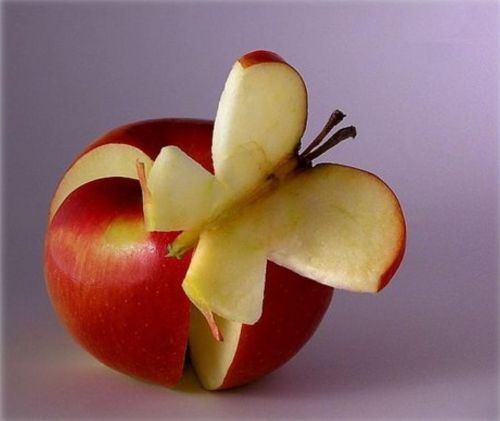
This week’s class fell on Rosh Hashonah, the first day of the Jewish New Year. In Jewish tradition, the first ten days of the year are considered the High Holy Days, the Days of Awe. There’s a sense that over these first ten days we lay the blueprint for the rest of the year. So the suggestion is to spend this time in quiet contemplation, taking stock of how we’ve moved towards the light, and how we’ve moved away. Along with this intensive self-inquiry, it’s traditional to eat apples dipped in honey, a symbolic act for bringing sweetness into our lives.
So I thought it only right to offer this class to sweetness and light…
Hence, I added srim, the Laksmi bija mantra, to last week’s mix of Gayatri and Om Namah Shivaya — andbrought in a group of Hafiz/Landinsky poems and a reading from Lawrence Kushner’s kabbalistic musings, Honey From the Rock.
For visitors unfamiliar with the Laksmi bija mantra, let me say a few things about srim — which I can’t properly transliterate here — fyi, it’s pronounced “shreem.” Srim is a seed mantra meaning it contains the full potency of the deity field. In this case, Laksmi, aka the power of splendor, magnificence, expansiveness, abundance… you get the idea. So the teachings go that whatever Laksmi touches grows into its most magnificent form. And sweetness is one of the attributes of Laksmi. This is a perfect sweetness. Not so sweet as to be cloying or just plain too sweet. This is the perfection of sweetness. The sweetness that makes us feel, well, let me say it like it is, positively delicious. We might say we experience the sweetness of Laksmi as a kind of effervescent grace. When all is right with our lives and infinity is possible…
Before I go on, let me also say a few things about Monday Night Class. There is much I love about this class. Its longevity. The people who find their way there. The depth and power of the teachings and practice. The sense of welcome, safety, and community. Sometimes though, I think what I love best is the sweetness of the laughter. Here’s a clip from this week’s class:
Here’s this week’s dharma talk. Which begins with the below posted Hafiz. This small group of poems offers an excellent teaching on what gets in the way of our ability/intention to live in and of our sweetness and light [and delight!] I’ll post the Kushner quote which I also read in this talk, below Hafiz. Kushner is writing specifically about Light. The two together make an excellent counterpoint on the topic of sweetness and light. Add in the mantras and we have a fugue for the heart…
Here are the Hafiz poems, from Daniel Landinsky’s book, The Gift.
THE SAD GAME,
Blame Keeps the sad game going. It keeps stealing all your wealth – Giving it to an imbecile with No financial skills. Dear one, Wise Up.
TIRED OF SPEAKING SWEETLY
Love wants to reach out and manhandle us, Break all our teacup talk of God. If you had the courage and Could give the Beloved His choice, some nights, He would just drag you around the room By your hair, Ripping from your grip all those toys in the world That bring you no joy. Love sometimes gets tired of speaking sweetly And wants to rip to shreds All your erroneous notions of truth. That make you fight within yourself, dear one, And with others, Causing the world to weep On too many fine days. God wants to manhandle us, Lock us inside of a tiny room with Himself And practice His dropkick. The Beloved sometimes wants To do us a great favor: Hold us upside down And shake all the nonsense out. But when we hear He is in such a “playful drunken mood” Most everyone I know Quickly packs their bags and hightails it Out of town.
DROPPING KEYS
The small man Builds cages for everyone He Knows. While the sage, Who has to duck his head When the moon is low, Keeps dropping keys all night long For the Beautiful Rowdy Prisoners.
FIND A BETTER JOB
Now That All your worry Has proved such an Unlucrative Business, Why Not Find a better Job.
I WISH I COULD SPEAK LIKE MUSIC
I wish I could speak like music. I wish I could put the swaying splendor of the fields into words so that you could hold Truth Against your body And dance. I am trying the best I can With this crude brush, the tongue, To cover you with light. I wish I could speak like divine music. I want to give you the sublime rhythms Of this earth and the sky’s limbs As they joyously spin and surrender, Surrender Against God’s luminous breath. Hafiz wants you to hold me Against your precious Body And dance, Dance.
Here’s the quote from Lawrence Kushner’s Honey from the Rock:
It is no accident that all the great creation tales begin with light. Of all the things that the Creator might have first formed – mountains, waterfalls, stars, flowers, fruited plains, lions and lambs, leviathans and whirlwinds, single-celled creatures and man – He made light. First of all the Holy One fashioned consciousness.
Let us retell the story of this light which is a metaphor for spiritual awareness: A light with which the Holy One began the creation. Let there be light and there was light. In the Zohar we read further of creation. Some kind of dark flame – blinding flash – issued forth from the innermost hiddenness – from the mystery of the Ayn-Sof, the Infinite One…. A light that was so dazzling that by it…man could gaze from one end of the universe to the other. A light so powerful that is shattered earthly vessels. A light that if it fell into the hands of the wicked could return creation itself back to primordial chaos. A light that therefore had to be hidden away. And God made a separation. A light that was set aside for the Tsadikim [the righteous ones]. Light is sown for the righteous… A light whose appearance initiates creation. But it is a creation only able to withstand a tiny bit of light. Therefore the light had to be concealed. And so it is that darkness and incompletion and separation are the price of this world. While light initiates existence, existence conceals light. For with the appearance of the light being began, But with the concealment of the light all manner of individuated existence was created… Just this is the mystery of the work of creation; And one who is able to understand will understand. A light imprisoned in the shards of this created world, waiting for us to free it. Returning itself and us to the Creator. A light so awesome that even a fraction of its splendor – just so much as a ray the thinness of a needle is all any of us need for unimaginable illumination.
Here’s a clip of this week’s chanting. I tried a different microphone placement, hoping to pick up less harmonium, more voices. Alas, I ended up with more harmonium. The call is quite clear, but I’m sorry to say the response is barely audible.
Finally, here’s a clip of the dharana I gave before gliding into silent meditation:
And when the topic is light, the last word goes to Devi, the Shining. This quote is found in the frontpiece of Ajit Mookerjee’s book, Kali, the Feminine Force. He cites Bhairava Yamala as the source text. I’ve never been able to find this text or any verse resembling the quote. A google search brings up nothing definitive. So I’m going to assume that Mookerjee had access to an unpublished text fragment and made this very beautiful translation. Wherever it comes from, whatever its source, it pulsates with sweetness, luminosity, and supreme bliss:
She is Light itself and transcendent.
Emanating from Her body are rays in thousands — two thousand, a hundred thousand, tens of millions, a hundred million — there is no counting their numbers. It is by and through Her that all things moving and motionless shine. It is by the light of this Devi that all things become manifest.





 The Monday Night Blog