April 28, 2017: Reading the Bhagavad Gita in the Age of Trump

Eagle in mountains

APRIL 24, 2017, BHAGAVAD GITA TALK #9. WHEN A MAN HAS LET GO OF ATTACHMENTS, WHEN HIS MIND IS ROOTED IN WISDOM, EVERYTHING HE DOES IS WORSHIP AND HIS ACTIONS ALL MELT AWAY. GOD IS THE OFFERING, GOD IS THE OFFERED, POURED OUT BY GOD; GOD IS ATTAINED BY ALL THOSE WHO SEE GOD IN EVERY ACTION.  [4.23-24]

I grew up without religious training or tradition. In our house, God was a strange word, rarely spoken, mostly disdained. So when I stumbled onto the yogic path and met Baba Muktananda, his core teaching, God dwells within you as you, struck me as the most radical thing I’d ever heard. It also struck me as absolutely true. So while the word itself is loaded and after all these many years still gives me a jolt, I do love the Gita verse I’ve quoted above: God is the offering, God is the offered, poured out by God; God is attained by all those who see God in every action. Yes!

Today we’re 99 days into the age of Trump. I keep thinking of the Upanishadic concept, neti neti, “not this, not this.” Anyone needing an example of everything that is not-God, need look no further than the Trump White House and Republican agenda, where neti neti, not-God, not-God, is on display day in day out…

Tomorrow is the People’s Climate March, happening on Trump’s hundredth day in office. If you’re on the fence about being part of this massive action, here’s a link to help you find a sister march.

I’ve lately been re-reading William Blake’s Marriage of Heaven and Hell. On the profoundly connected subjects of the climate march and God, I’ll leave you with two of my favorite quotes:

When thou seest an eagle, thou seest a portion of genius; lift up thy head!

For every thing that lives is Holy.

We’re back to Monday Night Class after a two-week break, digging into the Bhagavad Gita: Chapter Four, The Yoga of Wisdom.  This is a very rich topic that lends itself to parallel readings. Here’s audio of my rather free-wheeling dharma talk. It begins with a lovely commentary connecting the Tara mantra to our readings of the Gita. I also brought in a lovely hasidic story and beautiful passage from a Mary Oliver essay on Walt Whitman. Enjoy.

Here are this week’s verses from the Gita:

Actions cannot defile me,
since I am indifferent to results;
all those who understand this
will not be bound by their actions.

This is how actions were done
by the ancient seekers of freedom;
follow their example: act,
surrendering the fruits of action.

What are action and inaction?
This matter confuses even
wise men; so I will teach you
and free you from any harm. 

You must realize what action is,
what wrong action and inaction are
as well. The true nature of action
is profound, and difficult to fathom. 

He who can see inaction
in the midst of action, and action
in the midst of inaction, is wise
and can act in the spirit of yoga. 

With no desire for success,
no anxiety about failure,
indifferent to results, he burns up
his actions in the fire of wisdom. 

Surrendering all thoughts of outcome,
unperturbed, self-reliant,
he does nothing at all, even
when fully engaged in actions. 

There is nothing that he expects,
nothing that he fears. Serene,
free from possessions, untainted,
acting with the body alone, 

content with whatever happens,
unattached to pleasure or pain,
success or failure, he acts
and is never bound by his action. 

When a man has let go of attachments,
when his mind is rooted in wisdom,
everything he does is worship
and his actions all melt away. 

God is the offering, God
is the offered, poured out by God;
God is attained by all those
who see God in every action.  [4.14-24]    

Here are the parallel readings:

 I  

As the power of deliverance Tara is related to the goddess Durga, who similarly takes us across all difficulties. Hence she is also called Durga-Tara. Whereas Durga represents the power that overcomes or destroys obstacles and difficulties, Tara is the power which takes us beyond them. While Durga is more appropriate to call on in extreme danger wherein we need help against negative forces assailing us, Tara has the additional power to lift us up in life generally. Tara is the power to transcend all things. She not only lifts us beyond dangers but allows us to rise beyond our achievements and accomplishments to higher levels of realization. As the ultimate obstacle we have to cross over is our own mind, Tara provides the power to take us beyond the turbulent waves of our thought currents….

 [David Frawley, Tantric Yoga and the Wisdom Goddesses]

II

I celebrate myself,
And what I assume you shall assume,
For every atom belonging to me as good belongs
                  to you.
 
I loaf and invite my soul,
I lean and loaf at my ease…observing a spear
                  of summer grass.

             In these lines the great work has begun, and the secret of success has been given. And what is that great labor? Out-circling interest, sympathy, empathy, transference of focus from the self to all else; the merging of the lonely single self with the wondrous, never-lonely entirety. This is all.

[Mary Oliver, Upstream]

 III

A man who lived in the same town as Rabbi Zusya saw that he was very poor. So each day he went to the house of prayer and left twenty pennies so that Zusya and his family might eat. From that time on, the man grew richer and richer. The more he had, the more he gave Zusya, and the more he gave Zusya, the more he had.

One day he recalled that Zusya was the disciple of the great master, Rabbi Baer of Mezritch—and it occurred to him that if what he gave the disciple was so lavishly rewarded, he might become even more prosperous if he made presents to the master himself. So he travelled to Mezritch and made a substantial gift to Baer. From this time on, his means shrank until he lost all the profits he had made during the more fortunate period.

Taking his troubles to Rabbi Zusya, he told him the whole story and asked what his present predicament was due to. For had not the rabbi himself told him that his master was immeasurably greater than he?

Zusya replied: “Look! As long as you gave and did not bother to whom, whether to Zusya or another, God gave to you and did not bother to whom. But when you began to seek out especially noble and distinguished recipients, God did exactly the same.”

[Jack Kornfield, Stories of the Spirit, Stories of the Heart]

Finally, here’s audio of class chanting. This is the Tara mantra resolving into Om Namah Shivaya. This clip has a long slow fade-in so you may hear silence for the first 20 seconds. At around 3.40 minutes, I add a dharana on how these two mantras so beautifully complement and hold one another…

April 23, 2017: Reading the Bhagavad Gita in the Age of Trump

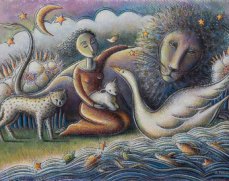
Peaceable Kingdom
Though the unwise cling to their actions,
watching for results, the wise
are free of attachments, and act
for the well-being of the whole world.  [3.25]

APRIL 4, 2017, BHAGAVAD GITA TALK #8: “THE WISE MAN DOES NOT UNSETTLE THE MINDS OF THE IGNORANT. QUIETLY, ACTING IN THE SPIRIT OF YOGA, HE INSPIRES THEM TO DO THE SAME.”

Yesterday being Earth Day and my birthday, I took some time off from thinking about politics and spirituality.  A lovely respite as we approach the 100-days point in the Trumpian debacle. I only wish they would take some time off. Like the rest of their lives…

If you’re a member of MoveOn, you most likely received email from Al Franken last week. For those who did not:

Dear MoveOn Member,

It’s Al Franken, and I’m writing you today because I’m worried. Not about what Donald Trump has tried (and, so far, failed) to do already, like Trumpcare and the Muslim ban. But about the storm that’s coming.

You see, we’re just 90 days into the Trump presidency. Fortunately, we’re also 90 days into a powerful resistance movement. Up until now, we’ve been doing surprisingly well stalling Trump’s agenda. But the thing is, he’s just getting started—so we can’t let up for a second.

There are so many more fights to come: Stopping Trump’s tax breaks for rich people like himself. Standing up to Jeff Sessions’ deportation force. Resisting attacks on Medicare and the environment. And we still have a year and a half before we’ve got a shot at taking back Congress.

Trump governs by chaos. He wants us to get tired and slow down, but we can’t let him win.

After Trump was elected, there was a huge spike in grassroots energy—the biggest I’ve seen in my entire political career. Record-setting numbers of people flooded the streets. It was impossible to get a call through to Congress (believe me, I know, because my office phone lines were ringing off the hook). And while my Republican colleagues are trying to put on a brave face, I can tell that they are under stress. (And that stress helped defeat their first attempt at Trumpcare!)

But here’s what has me worried: We’re fighting on so many fronts. And if energy drops off, we’ll start losing.

I share Franken’s concern. It’s what compelled me to begin this “Reading the Bhagavad Gita in the Age of Trump” project. It just seemed an excellent manual to read side-by-side with Democracy NowMoveOnIndivisible — whatever your preferred news and action alert portals. There is so much work to do and as Franken says, we have to fight on so many fronts. Along with Trump’s horrible appointments and policy agendas, he creates mind-blowing chaos that defies us to grab hold and make order. This is what makes him so dangerous. We have got to stay grounded in wisdom (and a sense of humor) else we risk profound overwhelm and burnout.

We also have got to hold onto our humanity. We can never allow ourselves to become like them.

Here’s my opening dharana and dharma talk from Monday, April 4th:


Here are the verses I read from the Gita:

Though the unwise cling to their actions,
watching for results, the wise
are free of attachments, and act
for the well-being of the whole world.

The wise man does not unsettle
the minds of the ignorant, quietly,
acting in the spirit of yoga,
he inspires them to do the same.

Actions are really performed
by the working of the three gunas;
but a man deluded by the I-sense
imagines, “I am the doer.”

The wise man knows that when objects
act on the senses, it is merely
the gunas acting on the gunas;
thus he is unattached.

Deluded by the gunas, men grow
attached to the gunas’ actions;
the insightful should not disturb
the minds of these foolish men.

Performing all actions for my sake,
desireless, absorbed in the Self
indifferent to “I” and “mine,”
let go of your grief and fight!

Men who constantly practice
this teaching of mine, Arjuna,
who trust it with all their heart,
are freed from the bondage of actions.

But those who, mistrustful, half-hearted,
fail to practice my teaching,
wander in the darkness, lost,
stupefied by delusion.

Even the wise man acts
in accordance with his inner nature.
All beings follow their nature.
What good can repression do

Craving and aversion arise
when the senses encounter sense-objects.
Do not fall prey to these two
brigands blocking your path.

It is better to do your own duty
badly, than to perfectly do
another’s; you are safe from harm
when you do what you should be doing.    [3.25-35]

ARJUNA SAID:

What is it that drives a man
to an evil action, Krishna,
even against his will,
as if some force made him do it?

THE BLESSED LORD SAID:

That force is desire, it is anger,
arising from the guna called rajas;
deadly and all-devouring,
that is the enemy here.

As fire is obscured by smoke,
as a mirror is covered with dust,
as a fetus is wrapped in its membrane,
so wisdom is obscured by desire.

Wisdom is destroyed, Arjuna,
by the constant enemy of the wise,
which, flaring up as desire,
blazes with insatiable flames.

Desire dwells in the senses,
the mind, and the understanding;
in all these it obscures wisdom
and perplexes the embodied Self.

Therefore you must first control
your senses, Arjuna; then
destroy this evil that prevents you
from ever knowing the truth

Men say that the senses are strong.
But the mind is stronger than the senses;
the understanding is stronger
than the mind; and the strongest is the Self.

Knowing the Self, sustaining
the self by the Self, Arjuna,
kill the difficult-to-conquer
enemy called desire..   .   [3.36-43]


And here are two audio clips of class chanting. The first is Om Tara Tuttare Ture Swaha; the second is Namo Kuan Shih Yin Pu’sa. With apologies for sound quality. We’re working on a recording upgrade.


HAPPY EARTH DAY WEEKEND TO YOU ALL

Peaceable Kingdom

April 16, 2017: Reading the Bhagavad Gita in the Age of Trump

He Qi, Easter Morning, painting

MARCH 27, 2017, BHAGAVAD GITA TALK #7: TRAVELING FROM THE OUTER LIMITS OF THE THINKING MIND INTO THE DEPTH OF INNER STILLNESS.  “PERFORMING ALL ACTIONS FOR MY SAKE, DESIRELESS, ABSORBED IN THE SELF, INDIFFERENT TO “I” AND “MINE,” LET GO OF YOUR GRIEF, AND FIGHT!

Easter Sunday. Ironic that this day of rebirth and resurrection ends another bizarre week in the Age of Trump. Bombs, bombs, and more bombs. I did wonder if the bombing spree was an attempt to distract us from the Russia-connection arrests rumored to be coming this week. Probably so. This is from the 4/13 Palmer Report...

Donald Trump dropped the “Mother of all Bombs” today in Afghanistan, but it appears to have been a mere attempt at distracting from the mother of all bombshells. Reliable sources, who have proven themselves correct in the past, are now pointing to U.S. intel agencies working with the Attorney General of New York to begin imminently dismantling Trump’s inner circle. In fact the big major arrests may come as soon as next week.

(Click here for the entire article.)

Let us hope the dismantling has begun. And that the Democratic Party can actually get its act together, win the next round of elections, and bring some semblance of sanity and humanity back to governing. In the meantime, can I just say that nicknaming a bomb “mother” is really sick. Especially one that resembles a ginormous phallus. And the acronym MOAB. Seriously? It makes this hideously destructive bomb sound like a pet guppy.

The Bhagavad Gita maintains that desire drives the psycho-pathology of men and women like Donald Trump. In the more integrative perspective of Tantra, we would say that it’s actually attachment to and/or identification with desire. But we need not bog down in philosophical hair-splitting. The bottom line is, desire, its near relative greed, and their offspringsdisplaced anger, cruelty, and the need to dominate and controlhave wreaked havoc on this planet for thousands of years…

Although we didn’t read these verses at the March 27 class, they’re so relevant to this moment, I thought I’d include them.

ARJUNA SAID:
 
What it is that drives a man to evil action, Krishna,
even against his will,
as if some force made him do it.
 
THE BLESSED LORD SAID:

That force is desire, it is anger,
arising from the guna called rajas;
deadly and all-devouring,
that is the enemy here.
 
As a fire is obscured by smoke,
as a mirror is covered by dust,
as a fetus is wrapped in its membrane,
so wisdom is obscured by desire.
 
Wisdom is destroyed, Arjuna,
by the constant enemy of the wise,
which, flaring up as desire,
blazes with insatiable flames.
 
Desire dwells in the senses,
the mind, and the understanding;
in all these it obscures wisdom
and perplexes the embodied Self.
 
Therefore you must first control
your senses, Arjuna; then
destroy this evil that prevents you
from ever knowing the truth.
 
Men say that the senses are strong.
But the mind is stronger than the senses;
the understanding is stronger
than the mind; and the strongest is the Self.
 
Knowing the Self, sustaining
the self by the Self, Arjuna,
kill the difficult-to-conquer
enemy called desire. [3.36-43]


Here’s my dharma talk from March 27th.


I read only two verses from the Gita during this talk. We’ve read these before but they’re well worth repeating…

The wise man does not unsettle
the minds of the ignorant; quietly
acting in the spirit of yoga,
he inspires them to do the same. [3.26]

It is better to do your own duty
badly, than to perfectly do
another’s; you are safe from harm
when you do what you should be doing. [3.35]

Here are the Mary Oliver poems that, as always, beautifully and ecstatically mirror what the Gita is teaching. The first we also read last week. Like the Gita verses above, it too bears repeating…

TODAY

Today I’m flying low and I’m
not saying a word.
I’m letting all the voodoos of ambition sleep.

The world goes on as it must,
the bees in the garden rumbling a little,
the fish leaping, the gnats getting eaten.
And so forth.

But I’m taking the day off.
Quiet as a feather.
I hardly move though really, I’m traveling
a terrific distance.

Stillness. One of the doors
into the temple.

GREEN, GREEN IS MY SISTER’S HOUSE

Don’t you dare climb that tree
or even try, they said, or you will be
sent away to the hospital of the
very foolish, if not the other one.
And I suppose, considering my age,
it was fair advice.

But the tree is a sister to me, she
lives alone in a green cottage
high in the air and I know what
would happen, she’d clap her green hands,
she’d shake her green hair, she’d
welcome me. Truly 

I try to be good but sometimes
a person just has to break out and
act like the wild and springy thing
one used to be. It’s impossible not
to remember wild and want it back. So

if someday you can’t find me, you might
look into that tree—of course
it’s possible—or under it.


I’m including two audio clips of class chanting, with apologies for less than stellar sound quality. During this Bhagavad Gita in the Age of Trump cycle of class, we’ve been chanting Tara and Kuan Yin mantras. I’ll write more about why I chose these mantras (or more accurately, why these mantras chose me) within the next few weeks. For now, suffice to say they are excellent medicine for moving through these times. They foster the ability to  hold the nightmare of the Trump regime without getting lost in our outrage, disgust, revulsion, fear, even hatred. And in that holding, we can channel these powerful energies into the fierce determination and wisdom necessary to keep fighting for truth and loving kindness to the world.

Here is the Tara mantra we chant at the opening of class.
OM TARA TUTTARE TURE SWAHA

Here is the Kuan Yin mantra which resolves into Om Namah Shivaya
NAMO KUAN SHIH YIN PU’SA 

April 12, 2017, Reading the Bhagavad Gita in the Age of Trump

Equinox w.o axis

MARCH 20, 2017: BHAGAVAD GITA TALK #6: THE YOGA OF PAYING ATTENTION “IN THIS WORLD THERE ARE TWO MAIN PATHS: THE YOGA OF UNDERSTANDING FOR CONTEMPLATIVE MEN; AND FOR MEN WHO ARE ACTIVE, THE YOGA OF ACTION.”

As I sit here writing, we are 84 days into the Age of Trump. If there was not so much at stake, we could chalk the madness up to dark comedy. Alas, it is actually happening. And the dizzying, psychotic mess that is the Trump regime is overwhelming at best, terrifying at worst, and just plain crazy-making in between. If you’ve spent time in the company of people at this end of the psychological spectrum, you know how easy it is to lose yourself in a twisted dance of wrong is right, down is up, and 2+2=5. While it’s good to see things from all sides, when one of those sides is bat-crap crazy, the balance is seriously disturbed.

It’s been extremely gratifying to see the pushback and results coming from the Resistance Movement. And we cannot let up for a moment. What we need to guard against however, is being pulled into the vortex of reactivity. We have to get really real inside of ourselves, pushing hard against unconscious motivation and drives. We need to act from truth, clarity, and a huge depth of wisdom. And thoughtful reading of the Bhagavad Gita is very helpful in this regard. At its core, this text reminds us to wake up, pay attention, and act for the benefit of all. It’s a powerful message that is, I know, much easier said than done. Nevertheless, if we are to right the nightmare of the Age of Trump, and I include in that nightmare all the wrongheaded agendas that brought us here, it is essential.

Here’s my dharma talk from March 20th. It was the Vernal Equinox so this talk opens with a short dharana welcoming Spring and constellates around Chapter 3 of the Gita.


Here are some verses from the chapter:

The superior man is he
whose mind can control his senses;
with no attachment to results,
he engages in the yoga of action. 3.7

The whole world becomes a slave
to its own activity, Arjuna;
if you want to be truly free,
perform all actions as worship. 3.

Without concern for results,
perform the necessary action;
surrendering all attachments,
accomplish life’s highest good. 3.19

Only by selfless action
did Janaka and other wise kings
govern, and thus assure
the well-being of the whole world. 3.20

Whatever a great man does
ordinary people will do;
whatever standard he sets
everyone else will follow. 3.21

Here are the Mary Oliver Poems I read:

TODAY

Today I’m flying low and I’m
not saying a word.
I’m letting all the voodoos of ambition sleep

The world goes on as it must,
the bees in the garden rumbling a little,
the fish leaping, the gnats getting eaten.
And so forth.

But I’m taking the day off.
Quiet as a feather.
I hardly move though really, I’m traveling
a terrific distance.

Stillness. One of the doors
into the temple.

THE MOTH, THE MOUNTAINS, THE RIVERS

Who can guess the Luna’s sadness who lives so
briefly? Who can guess the impatience of stone
longing to be ground down, to be part again of
something livelier? Who can imagine in what
heaviness the rivers remember their original
clarity?

Strange questions yet I have spent worthwhile
time with them. And I suggest them to you also,
that your spirit grow in curiosity, that your life
be richer than it is, that you bow to the earth as
you feel how it actually is that we—so clever, and
ambitious, and selfish, and unrestrained—are only
one design of the moving, the vivacious many.

If you’d like to read the NY Times article by Joel Whitebook I referenced in my talk, click here.

And a PS to my previous post. Here are some beautiful verses from the Jnaneshwari commenting on the Gita’s teaching on stitha prajna, steady wisdom.

O Arjuna, if you want to have the vision of wisdom, pay attention to Me.  I will explain to you how to recognize wisdom.

You may recognize wisdom in a person who has patience without intolerance.

He patiently bears all things, just as a person wears his favorite ornaments.  Even if calamity should come to him, he wouldn’t be overwhelmed by it.

His attitude is one of glad acceptance, whether he obtains what he wants or what he doesn’t want.

Be bears with equanimity both honor and shame, he is the same in happiness and sorrow, and he isn’t affected differently by praise or blame.

He isn’t scorched by heat, nor does he shiver with cold.  He isn’t intimidated by anything.

Just as Mount Meru doesn’t feel the weight of its own peaks, nor does the boar feel the burden of the earth, and just as the entire creation doesn’t weigh down the earth, in the same way, he doesn’t sweat under the pressure of the pairs of opposites.

Just as the ocean swells to receive the water of all the rivers flowing into it, similarly, there is nothing that such a person cannot bear with equanimity, and he has no memory even of what he has suffered.

Whatever happens to his body he accepts as his own, and he takes no credit for what he suffers. 

O Arjuna, he who practices such quiet endurance adds greatness to wisdom.


April 7, 2017: Reading the Bhagavad Gita in the Age of Trump

MARCH 6, 2017, BHAGAVAD GITA TALK #5: WHEN A MAN GIVES UP ALL DESIRES THAT EMERGE FROM THE MIND, AND RESTS CONTENTED IN THE SELF, BY THE SELF, HE IS CALLED A MAN OF FIRM WISDOM. [2.55]

Steady Wisdom3

It’s been a dizzying week in the Age of Trump. Kushner up, Bannon down. Gorsuch in, filibuster out. Nunes falls, Conaway rises. Not to mention North Korea, China,  Syria, and Russia. I started writing this post last night, concerned that with Trump’s approval numbers plummeting, he’d be looking for a war. But I never thought he’d move so quickly. I tend to keep a pretty cool head, but honestly, when I saw the news last night my heart stood still. I have not agreed with American policy regarding the nightmare in Syria, but starting World War III is not the solution…

Which brings me back to the Bhagavad Gita’s teachings around stitha prajna, what I’ve always referred to as “steady wisdom.” Mitchell translates stitha prajna as “firm wisdom” and since we’re using his translation, I’ll defer to that language. First though, let’s have a look at the Gita’s succinct definition of what firm wisdom is not:

If a man keeps dwelling on sense-objects, attachment to them arises; from attachment, desire flares up; from desire, anger is born; from anger, confusion follows; from confusion, weakness of memory; weak memory—weak understanding; weak understanding—ruin. [2.62-63]

Needless to say, this pathology is perfectly embodied in Trump and his administration. And what can we do in the presence of rampant delusion and cruelty but keep pushing back. Arm ourselves with stitha prajna and as Krishna instructs Arjuna at the beginning of the Gita, stand up and fight…

When a man gives up all desires
that emerge from the mind, and rests
contented in the Self by the Self,
he is called a man of firm wisdom. [2.55]

Though the unwise cling to their actions,
watching for results, the wise
are free of attachments and act
for the well-being of the whole world. [3.25]

Cultivating stitha prajna is the work of a lifetime. And it certainly requires focused committed inner work alongside focused committed outer work. But every time we push deeper inside ourselves, unravelling the knots of psycho/emotional wounding and clearing the debris of the past, we create more space for our innate stitha prajna, our steady wisdom, to breathe. And that is a great and noble weapon. Every exhalation sends a flare of sanity into the world.

Here’s my dharma talk from March 6.

March 20, 2017: Reading the Bhagavad Gita in the Age of Trump

FEBRUARY 6, 2017, BHAGAVAD GITA TALK #2: NONBEING CAN NEVER BE; BEING CAN NEVER NOT BE. BOTH THESE STATEMENTS ARE OBVIOUS TO THOSE WHO HAVE SEEN THE TRUTH.

Soon after we began reading the Bhagavad Gita, I was listening to a radio news show, I think it was NPR’s All Things Considered, and learned that Steve Bannon is a big fan of the Gita. Checking this out online, I discovered that Heinrich Himmler was also an admirer. He evidently kept a leather bound copy with him at all times. So we have Bannon, the architect of Trump’s policy agenda, and Himmler, the architect of the Nazi “Final Solution,” twisting the ideal of dharma to serve their twisted worldview. Two sociopaths fixated on the Gita’s notion of righteous war to justify their own pathologies. If you want an example of the dangers of belief, I give you this: Himmler believed Hitler was an incarnation of Krishna. One can only hope Bannon is not similarly deluded about the monster he serves.

It does give one pause.
And begs the question: How do we discern truth from belief?

The Bhagavad Gita may use the notion of “righteous war” to start a conversation. But the conversation is not about war. It’s about consciousness. The conversation between Arjuna and Krishna is a mirror of the conversation that goes on inside of us all the time. The conversation between the small self or ego (what we refer to in Yoga as the “I-maker”) and the Great Self of the Heart. And by “Heart,” I mean the ineffable hugeness that doesn’t speak in words. It’s more like a quivering or shimmering from deep within us. In those miraculous moments when we ground there, we embody everything the Gita teaches. In fact, in those miraculous moments, we are the Gita.

What Bannon doesn’t understand now and what Himmler didn’t understand then, is that we don’t go to war against the “other,” we go to war against that inside of us which creates the idea of “other.” We go to war inside of ourselves against the notion that we are somehow separate from and entitled to destroy that “other.” We go to war against this outmoded paradigm that has always been questionable and has demonstrated over a few thousand years that the only thing it excels at is making a tremendous mess of everything it touches.

We have to read the Gita the same way we should live our lives. We have to slip beneath the surface, read between the lines. We have to probe deeper and deeper, within a text, within ourselves, until the mind becomes so spacious, so still, that the “I”’ that drives the historical, cultural, psycho-emotional, and spiritual narratives that rule us ceases to be. Only in that stillness is the possibility of insight, and only in that insight, the possibility of truth. Anything that comes before that must be questioned.

I was talking with someone recently who was feeling very uncertain about her own gifts, and along with that, judging herself for not being more certain. This is the trap of dualistic thinking. It’s not about hard-edged certainty or soft edgeless uncertainty. Certainty and uncertainty are opposite poles of a stuckness that is quite destructive either way. What we want to develop is clarity. Which is neither certainty nor uncertainty. It’s just clarity. In that koan-like way Verse 2.16 so eloquently sings: “Nonbeing can never be; being can never not be. Both these statements are obvious to those who have seen the truth.’

Here’s my dharma talk from February 6. Which was Bhagavad Gita Talk #2, a rather freewheeling contemplation on the first forty or so verses from Chapter Two, The Practice of Yoga.

Here are the verses from this talk.  (If you’re visiting this blog for the first time, please note we’re working with Stephen Mitchell’s translation of the Bhagavad Gita. See my last post for more on that.)

Although you mean well, Arjuna
your sorrow is sheer delusion.
Wise men do not grieve
for the dead or the living.

Never was there a time
when I did not exist, or you,
or these kings; nor will there come
a time when we cease to be.

Just as, in this body, the Self
passes through childhood, youth,
and old age, so after death
it passes to another body.

Physical sensations—cold
and heat, pleasure and pain —
are transient: they come and go:
so bear them patiently, Arjuna.

Only the man who is unmoved
by any sensations, the wise man
indifferent to pleasure, to pain,
is fit for becoming deathless.

Nonbeing can never be;
being can never not be.
Both these statements are obvious
to those who have seen the truth.

The presence that pervades the universe
is imperishable, unchanging,
beyond both is and is not:
how could it ever vanish?

These bodies come to an end;
but the vast embodied Self
is ageless, fathomless, eternal.
Therefore you must fight, Arjuna.

If you think the Self can kill
or think that it can be killed,
you do not well understand
reality’s subtle ways.

It never was born; coming
to be, it will never not be.
Birthless, primordial, it does not
die when the body dies.

Knowing that it is eternal,
unborn, beyond destruction,
how could you ever kill?
And whom could you kill, Arjuna?

Just as you throw out used clothes
and put on other clothes, new ones,
the Self discards its used bodies
and puts on others that are new.

The sharpest sword will not pierce it;
the hottest flame will not singe it;
water will not make it moist;
wind will not cause it to wither.

It cannot be pierced or singed,
moistened or withered; it is vast,
perfect and all-pervading,
calm, immovable, timeless.

It is called the Inconceivable,
the Unmanifest, the unchanging.
If you understand it in this way,
you have no reason for sorrow.

Even if you think that the Self
is perpetually born and perpetually
dies—even then, Arjuna,
you have no reason for your sorrow.<

Before birth, beings are unmanifest;
between birth and death, manifest;
at death, unmanifest again.
What cause for grief in all this?

Some perceive it directly
in all its awesomeness; others
hear of it and never know it.

This Self who dwells in the body
is inviolable, forever;
therefore you have no cause to grieve
for any being Arjuna.

Know what your duty is
and do it without hesitation/
For a warrior, there is nothing better
than a battle that duty enjoins.

Blessed are the warriors who are given
the chance of a battle like this,
which calls them to do what is right
and opens the gates of heaven.

But if you refuse the call
to a righteous war, and shrink from
what duty and honor dictate,
you will bring down ruin on your head.

Decent men, for all time,
will talk about your disgrace;
and disgrace, for a man of honor,
is a fate far worse than death.

These great heroes will think
that fear has driven you from battle;
all those who once esteemed you
will think of you with contempt.

And your enemies will sneer and mock you:
“The mighty Arjuna, that brave man—
he slunk from the field like a dog.”
What deeper shame could there be?

If you are killed, you gain heaven;
triumph and you gain the earth.
Therefore stand up, Arjuna;
steady your mind to fight.

Indifferent to gain or loss,
to victory or defeat,
prepare yourself for the battle
and do not succumb to sin.

This is philosophy’s wisdom:
now hear the wisdom of yoga.
Armed with this understanding,
you will shatter your karmic bonds.

On this path no effort is wasted,
no gain is ever reversed;
even a little of this practice
will shelter you from great sorrow.

And as often is the case, the final word goes to Mary Oliver:

HOW TURTLES COME TO SPEND THE WINTER IN THE
AQUARIUM, THEN ARE FLOWN SOUTH AND
RELEASED BACK INTO THE SEA

Somewhere down beach, in the morning, at water’s edge, I found
   a sea turtle,
its huge head a smoldering apricot, its shell streaming with
   seaweed,
its eyes closed, its flippers motionless.
When I bent down, it moved a little.
When I picked it up, it sighed.
Was it forty pounds, or fifty pounds, or a hundred?
Was it two miles back to the car?
We walked a little while, and then we rested, and then we
   walked on
I walked with my mouth open, my heart roared.
The eyes opened, I don’t know what they thought.
Sometimes the flippers swam at the air.
Sometimes the eyes closed.
I couldn’t walk anymore, and then I walked some more
while it turned into granite, or cement, but with that
   apricot-colored head,
that stillness, that Buddha-like patience, that cold-shocked
   but slowly beating heart.
Finally, we reached the car.

                                                       ***

The afternoon is the other part of this story.
Have you ever found something beautiful, and maybe just in time?
How such a challenge can fill you!
Jesus could walk over the water.
I had to walk ankle-deep in the sand, and I did it.
My bones didn’t quite snap.

 Come on in, and see me smile.
I probably won’t stop for hours.
Already, in the warmth, the turtle has raised its head, is
   looking around.
Today, who could deny it, I am an important person.

–Mary Oliver, House of Light

Tuesday, November 8, 2016

election-day-2016A beautiful day in Princeton. Walking over to vote this morning, I felt such a sense of the importance of this small act of civic responsibility. Which, politically cynical as I’ve grown over the years, surprised me. And then, even more surprising, the thrill I felt as I cast my vote. But what surprised me most of all were the tears that welled up as I walked out of my polling place.

So much divides us. The country seems as polarized as it was during the Civil War. One wonders where we go from here. How does Hillary (and I trust she will win this election) begin to heal the gulf. How do any of us reach out to the other side. These are the big questions. And if neuropolitical research is correct, our political stance is predetermined in our hard wiring.

Listening helps. Standing less on the side of being right, more on the side of being open helps. These are skills we can develop as long as we’re willing to step outside our own definitions of what is right, and feel the fear or pain or hatred of another. Is my fear of Donald Trump any different than a Trump supporter’s fear of Hillary Clinton. Same fear. Just pointed in a different direction.

At class last night I read from Baba Muktananda’s 1981 book, Where Are You Going? As relevant today as it was 35 years ago.

Today the world is said to be making more and progress, but in what way has it become greater… All over the world there is hatred among nations, hostility among political parties, animosity among societies, and enmity among races and classes. People talk about innovation and reform, but in the name of these things they have succeeded only in destroying the environment, in wrecking family life, and increasing selfishness and hostility.

In such a world there is only one thing we need, and that is the true understanding of humanity. Yet that is exactly what we lack. Why does a human being behave as he does? Why does he create barriers between himself and others? He does these things because he lacks true understanding about himself. He does not know the greatness that lies within the human heart. Yet if he were to look within himself, he would realize that he contains the divinity of the entire world.

Perhaps, in the end, it all comes down to Love. The kind of love that stretches across the boundaries and holds us strong in its embrace. The love that’s called agape or maitri. It’s what I touched this morning when those tears welled up. Last thing I ever expected to happen. Yet there it was, shimmering inside of me, waiting for me to open up and feel its grace.

I read this beautiful poem by Marie Howe at class last night. It’s deep. if you don’t already know it, read it out loud several times at least and it will come alive for you…

Annunciation

Even if I don’t see it again — nor ever feel it
I know it is — and that if once it hailed me
it ever does–

and so it is myself I want to turn in that direction
not as toward a place, but it was a tilting
within myself,

as one turns a mirror to flash the light to where
it isn’t — I was blinded like that — and swam
in what shone at me

only able to endure it by being no one and so
specifically myself I thought I’d die
from being loved like that.

-Marie Howe

Monday, November 7, 2016

I cannot believe it is already November. And thank goddess the presidential campaign is over tomorrow.Or let us hope it ends tomorrow with no re-count challenges…

At class last week, we were contemplating the five koshas as described in the Taittiriya Upanishad. A fancy way to articulate the various levels (aka bodies) that weave through the ultimate oneness of our human being-ness. The more I think about it, the more I think that while this way of breaking it down into categories has its place in the work of developing mastery, I do believe Mary Oliver says it all way more beautifully….

WHAT CAN I SAY
-Mary Oliver

What can I say that I have not said before?
So I’ll say it again.
The leaf has a song in it.
Stone is the face of patience.
Inside the river there is an unfinishable story
  and you are somewhere in it
and it will never end until all ends.

Take your busy heart to the art museum and the
   chamber of commerce
but take it also to the forest.
The song you heard singing in the leaf when you 
   were a child
is singing still.
I am of years lived, so far, seventy-four,
and the leaf is singing still.

When I was meditating this morning, I found my mind contemplating the question, “Why?” Why do I meditate?  Why have I been doing this practice now for nearly forty years? What have I received? Have I done it to receive anything? What’s the bloody point of it all? Why do I teach it to others?

And I remembered, being in high school, maybe my junior year. 1964 or 1965. I was reading Herman Hesse’s Siddhartha. I can still feel myself lying on the living room couch in my family’s home absorbed in that narrow paperback. And I came to the end of the story, where he has attained something wonderful. He has attained stillness. And every cell in my being started to pulsate. I didn’t know how to find what he found, but in that moment, my quest began…

So why do I meditate? All those years in Siddha Yoga formed a habit. What began as a quest and became a rigid following of  ashram discipline — (really rather fear-based if I speak the truth to you now) — just became something I do.

Like breathing. Or sleeping. Or drinking chai.

And at this point in my life, to borrow a phrase from Mary Oliver, I am of years lived, so far, sixty-eight… And find I don’t need a reason. In fact, I question if having a reason is actually counter to the practice.

Meditating may contribute to my health and vitality —
may help to anchor my insight and intuition —
may foster an inner glow —
but I realized this morning that I don’t do it for any of those reasons.

I just meditate to meditate.

If I have a reason, it’s something like for the sheer joy of being alive and experiencing the sometimes beautiful, sometimes terrible, sometimes wonder-filled, sometimes terrifying life/death dance of life.

Which is more than enough reason for me.

* * * *

Tomorrow is Election Day in the USA. If you’re a US citizen, please vote!!! Because even though it seems like it barely makes a difference. That the status quo remains the status quo. That our so-called leaders remain in the pockets of corporate lobbyists. Still, somehow, in the big picture, it does matter. If only to elect someone who understands the climate crisis is here and it is real. And that is Hillary Clinton. Whether she’ll be able to do anything about it, probably only those incremental steps she’s famous for. And whether incremental steps are enough… I don’t think so. Nevertheless, I’m voting for Hillary. Not because she’s inspired me as a candidate. (She has not.) Not because she’s a woman. (To me it’s less about gender and more about consciousness.) Not because I particularly want to see Bill Clinton back in the White House. (It actually kind of creeps me out.) I’m voting for Hillary Clinton because I think she is far and away the best choice we have. And while I don’t agree with all her policies. And have concerns about how enmeshed she is in politics as usual. Still, I have real respect for her intelligence, wonkiness, and discipline. And suspect that although she doesn’t often show it in her public persona, I think she actually cares. And while I don’t think that’s enough. I do think it’s a starting point. We just need to ensure she is elected. And then keep pushing her to govern from that sense of care. Not from fear. Not from greed. Not from a need to dominate. To govern with care for everything that lives and breathes and is of this Earth we all call home…

Communication, Communion, and the Mind According to Yoga…

P1000600_2

I think a lot about listening. What it means to really listen to oneself. What it means to listen to another. What is means to listen to the world. How do we cultivate ears that truly hear. How do we foster a communication between ourselves and everything of our world that makes communion happen. So much gets in the way of that. So much mucks up the clear space within and around us. So that rather than communion, we often end up with separation. We cling to our belief systems. We cling to our stories. We cling to our idea of being right. Which doesn’t let in much space for listening. We’re too busy telling…

Here’s a talk about listening that weaves in yogic teachings on the mind, aka, the Four-Part Psychic Instrument or antahkarana. Like so much passed down through the Hindu Yogic system, this perspective on the mind is quite simple and profound. I unpack it in the talk, but here are the technical terms spelled out.

The four levels of antahkarana or the Four-Part Psychic Instrument

Manas: often translated as mind-stuff. From our western perspective, think of it as your conscious mind.

Chitta: translated in a myriad of ways. From our western perspective, think of it as the unconscious.

Ahamhara: in the yogic system, this is the sense of “I.” Often referred to as the ego.

Buddhi: the discriminating faculty.

Here’s the talk:

And here is a wonderful poem from Mary Oliver who is perhaps one of the greatest listeners we have.


The Fist
Mary Oliver
 
There are days
when the sun goes down
like a fist,
though of course

if you see anything
in the heavens
in this way
you had better get

your eyes checked
or, better still,
your diminished spirit.
The heavens

have no fist,
or wouldn’t they have been
shaking it
for a thousand years now,

and even
longer than that,
at the dull, brutish
ways of mankind—

heaven’s own
creation?
Instead: such patience!
Such willingness

to let us continue!
To hear
little by little,
the voices—

only, so far, in
pockets of the world—
suggesting
the possibilities

of peace?
Keep looking.
Behold, how the fist opens
with invitation.

from Thirst, Beacon Press, 2006.

6/06/16 Monday Night Class: Sun Mantras, Ganesha, and the Incredible Lightness of Being…

13330921_10157248014180227_2932591289537748488_n

This week’s class fell on 6/06/16 which got me thinking about the significance of the number six. If you stop think about it, the number six is composed of 2 3’s and/or 3 2’s. The 2’s represent opposite poles and the movement towards balance. The 3’s represent a unifying synthesis, the sacred trinity we find in so many traditions. When you put that all together, you can see why you end up with a number that is connected to the exuberant amazing glorious expressive, and most of all life-giving Sun…

Here’s a quote from Vicki Noble’s Motherpeace Tarot:

Sixes: Exuberance

The Sixes are full and expressive, a peak number, always expansive and positive in some way. Six represents exuberance or triumph, being on top of things. Like the Sun sitting at the center of the solar system, Six sits at the center of the Kabalistic Tree of Life and radiates out in every direction, saying, “yes!” Six represents a moment of decisive action or a climax of some sort, a moment of glory.

Which all seemed an excellent jumping off point for a class that constellated around the fifth Sun mantra, the creation story of Ganesha, and the inner possibility of soaring…

ॐ खगाय नमः
om khagāya namaḥ |
Salutations to Khaga, who travels the sky like a bird…

I love all the Sun mantras, but this is one that always jumps out at me. I love the image of light traveling through the sky like a bird. I also love the way “light” as in light and “light” as in lightness are so connected. Which gets me thinking about the incredible lightness of being we feel in the presence of people who are, well, full of light. People who have a buoyancy of spirit and soul that soars like a bird. And what a delight (there’s that word again) to have them in our lives. Because let’s face it. Most of us lean towards the heaviness of being. We are gravity-based creatures. And that’s not just the gravity of Earth. There’s a potent gravitational force in the demands of daily life, in the stress we hold in our bodies, in the narratives and belief systems that can (and often do) keep us down. Although we don’t like to admit it, many of us prefer to be stressed out. It’s familiar, provides solid reasons for everything that’s not working in our lives, and most of all, distracts us from remembering we are finite being living in an unfathomable mystery we will never be able to control. The irony being that the Mystery does seem to be made of light…


Here’s my opening dharana on the mantra Om Namaha Shivaya  as a bird with two wings:


And here is this week’s dharma talk, a weaving of the well-known creation story of Ganesha from the Shiva Purana with 5th Sun mantra. I’m interested in what it takes to foster the incredible lightness of being embodied in Ganesha and articulated in this mantra. One point I didn’t get into in this talk is looking at Ganesha as a threshold keeper. If you look at the two common epithets assigned to “him,” Lord of Beginnings and Gatekeeper of the Sacred Feminine, you can see what I’m talking about. But what does that really mean, to be a threshold keeper. Ganesha resides in the space between, embodying a perfect balance, a lightness of being that makes it possible to ride on the back of mouse without crushing it. In my opinion, this is the reason for spiritual practice. So that we can walk lightly on the Earth, lightly through ups and downs of daily life, and perhaps most important since it makes these first two possible, walk lightly within ourselves…


The Glow of Your Presence
Hafiz  [English version by David and Sabrineh Fideler]

Where have you taken your sweet song?
Come back and play me a tune.

I never really cared for the things of this world.
It was the glow of your presence
that filled it with beauty.