Monday, July 16, 2012

We’re continuing our focus on Patanjali Book III, but adding Laksmi Work to the mix. Something about summer, the abundance of greenery, produce, heat and humidity has me contemplating the force of Laksmi in all its complexity, wonder, and power… Here are the sutras we read this evening:
III,6. Perfect discipline is mastered in stages.
III, 7. These three components – concentration, absorption, and integration – are more interiorized than the preceding five.
III, 8. Even these three are external to integration that bears no seeds.
III, 9. The transformation towards total stillness occurs as new latent impressions fostering cessation arise to prevent
the activation of distractive stored one, and moments of stillness begin to permeate consciousness.
III, 10. These latent impressions help consciousness flow from one tranquil moment to the next.
III, 11. Consciousness is transformed toward integration as distractions dwindle and focus arises.
III, 12. In other words, consciousness is transformed toward focus as continuity develops between arising and
subsiding perceptions.
Readers of this blog who attend class with some regularity, or are conversant with these teachings, will find the above sutras fairly straightforward. If, on the other hand, this language is less than familiar, it may seem undecipherable. So let me say that Patanjali is breaking the movement of mind and breath into carefully delineated categories. And in these sutras, he’s giving us a clue about how to live with an internal sense of freedom and ease. Otherwise known as mastery…
Which is how the Laksmi Work comes into my mind…

I’ll be weaving these two, Patanjali Book III and the Laksmi Work together over the next few weeks. For now I want to get this week’s dharma talk, readings, and chanting clips posted, so will keep this brief.

Here’s a clip of this week’s chanting the yoga sutras:

This is a clip of my dharma talk. It runs long, around 27 minutes.  No big surprise as we read so many sutras this evening. I was particularly focused on III, 8, where Patanjali brings in the notion of seeds of karma. But along with that, this talk, while free-wheeling as my talks often are, begins to tie together threads of Patanjali Book III and the Laksmi Work:
Here are the poems, from Rumi and Mary Oliver, that I read at the close of my talk:
Two from Rumi:

There’s a hidden sweetness
in the stomach’s emptiness.
We are lutes, no more, no less. If the soundbox
is stuffed full of anything, no music.
If the brain and belly are burning clean
with fasting, every moment a new song comes
out of the fire. The fog clears, and a new energy
makes you run up the steps in front of you.
Be emptier and cry like reed instruments cry.
Emptier, write secrets with the reed pen.
When you’re full of food and drink, Satan sits
where your spirit should, an ugly metal statue
in place of the Kaaba. When you fast,
good habits gather like friends who want to help.
Fasting is Solomon’s ring. Don’t give it
to some illusion and lose your power.
But even if you’ve lost all will and control,
they come back when you fast, like soldiers appearing
out of the ground, pennants flying above them.

*********

Submit to a daily practice.
Your loyalty to that
is a ring on the door.
 
Keep knocking, and the joy inside
will eventually open a window
and look out to see who’s there.
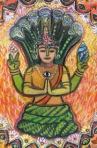
This is a clip of chanting the mantra Om Namah Shivaya:
This is a clip of the closing meditation:

Monday, July 9, 2012

This week’s class focused on one sutra. I thought the dawning of wisdom deserved an evening unto itself.

III, 5
Once the perfect discipline of consciousness is mastered,
wisdom dawns.
Just to reiterate, Patanjali’s Book III concerns itself with the final three limbs of classical yoga:  concentration (dharana), meditation/absorption (dhyana) and integration (samadhi). These three limbs form the perfect discipline of consciousness, aka samyama, referred to in the above sutra.
If you imagine the mind/body system as myriad layers of consciousness, some clear, some dense, some hard, some soft, some open, some closed, some sticky, some slippery — you get where I’m going with this — you can see why it’s so hard to get the whole mess integrated. All this to say the practice of samyama  does not come easily. We have to work at it. The mind is a slippery instrument, more often attuned to the kleshas, than its innate wisdom. [Should you want to review the kleshas, go to the May 2011 archive]. Yet wisdom, like the sun, is always blazing. We may be oblivious to its light. That doesn’t mean it’s not here. Which is why taking a moment to turn within can evoke a profound sense of clarity, calm, insight, or wisdom. Of course, Patanjali’s technology for yoking the mind/body system is designed so those moments of clarity, calm, insight, and wisdom stretch into the norm.
This week’s dharma talk attempts to unpack some of the above:
For reasons that will become clear over the next few weeks, I’m feeling a connection between the teachings and practices I’ve come to call the Laksmi Work and our current immersion in Patanjali Book III. More on that as it unfolds. For now, suffice to say we opened class chanting the Laksmi-Murti-Mantra combined with the Dhumavati Bija. I’ll write these mantras out for those unfamiliar with them and also include a clip of the actual chanting:
Here are the mantras:
Here’s an audio clip of the chanting:
Contemplating wisdom inspired me to go down the rabbit hole of parallel teachings:
From the Laksmi Tantra:
I am recognized by the wise as the bliss and tranquility inherent in each state of being. Though that is my true nature, [the individual] does not experience me spontaneously. However, after receiving a mere particle of my anugrahashakti [grace], she discovers me instantaneously…Then after propitiating me by various means [i.e. samyama], the jiva [individual soul] washes away all the kleshas and blows away the dust of impressions; whereby the jiva that has already severed its fetters through meditation, fuses with true knowledge [aka wisdom] and attains me, who am Laksmi and whose nature is supreme bliss.
From the Jneshwari:

 What is action? What is inaction? Thus, even the wise are confused in this matter. This action, I shall explain to you, having known which, you shall be released from evil [i.e. the lack of wisdom].

 One must know the nature of action, the nature of wrong action, and also the nature of inaction. The way of action is profound.

 He who perceives inaction in action, and action is inaction is wise among men; he is is a yogi and performs all actions.

 Such a person seems like other people, but he is not affected by human nature like the sun which cannot be drowned in water.

 He sees the world without seeing it, does everything without doing it, and enjoys all pleasures without being involved in them.

 Though he is seated in one place, he travels everywhere, for even while in the body he has become the universe.

From the Ashtavakra Gita:

1.
The wise man knows the Self,
And he plays the game of life.
 
But the fool lives in the world
Like a beast of burden.
 

2.
The true seeker feels no elation,
Even in that exalted state
Which Indra and all the gods
Unhappily long for.
 

3.
He understands the nature of things.
 
His heart is not smudged
By right or wrong,
As the sky is not smudged by smoke.
 

4.
He is pure of heart,
He knows the whole world is only the Self…
 

5.
Of the four kinds of being…
Only the wise man is strong enough
To give up desire and aversion.

From Lalleshwari , tr. by Coleman Barks

The soul, like the moon,
is new, and always new again.

And I have seen the ocean
continuously creating.

Since I scoured my mind
and my body, I too, Lalla,
am new, each moment, new.

My teacher told me one thing,
Live in the soul.

When that was so,
I began to go naked,
and dance.

Trying to be Thoughtful in the First Brights of Dawn
-Mary Oliver

I am thinking, or trying to think, about all the
imponderables for which we have
no answers, yet endless interest all the
range of our lives, and it’s

 
good for the head no doubt to undertake such
meditation; Mystery, after all,
is God’s other name, and deserves our

 
considerations surely. But, but —
excuse me now, please; it’s morning, heavenly bright,
and my irrepressible heart begs me to hurry on
into the next exquisite moment.

[w/ humble apologies to MO for this blog template’s refusal to format her poem as written…] 

Sunday, July 8, 2012, Part II

Here are notes from July 2, last week’s class. The sutra for the evening was:

III, 4
Concentration, absorption, and integration regarding a single object
compose the perfect discipline of consciousness.
For as long as Monday Night Class has gathered in Princeton, which is well over ten years now, we’ve chanted the mantra Om Namah Shivaya as a vehicle for meditation. In the spirit of this sutra however, I thought it would be interesting to work with the mantra, less as a vehicle, more as that single object Patanjali is referring to. For a group of chanting  bhaktas, this is a more difficult practice. And in that way I think, very fruitful.
Here’s my dharma talk for this class:
 And here are the parallel readings. The first is from Thomas Byrom’s gorgeous translation of the Ashtavakra Gita, a text that pulsates with the life force of samadhi:

Dissolving
 
1
You are pure.
Nothing touches you.
What is there to renounce?
 
Let it all go,
The body and the mind.
 
Let yourself dissolve.
 

2
Like bubbles in the sea,
All the worlds arise in you.
 
Know you are the Self.
Know you are one.
 
Let yourself dissolve.
 

3
You see the world.
But like the snake in the rope,
It is not really there.
 
You are pure.
 
Let yourself dissolve.
 

4
You are one and the same
In joy and sorrow,
Hope and despair,
Life and death.
 
You are already fulfilled.
 
Let yourself dissolve.

And as often happens, I give the final word to Mary Oliver, whose poetry pulsates with the life force of waking up:

The Poet is Told to Fill Up More Pages
Mary Oliver

But, where are the words?
Not in my pocket.
Not in the refrigerator.
Not in my savings account.
So I sit, harassed, with my notebook.
It’s a joke, really, and not a good one.
For fun I try a few commands myself.
I say to the rain, stop raining.
I say to the sun, that isn’t anywhere nearby,
Come back, and come fast.

Nothing happens.
So this is all I can give you,
not being the maker of what I do,
but only the one that holds the pencil.

abcdefghijklmnopqrstuvwxyz
Make of it what you will.

Monday, June 25, 2012

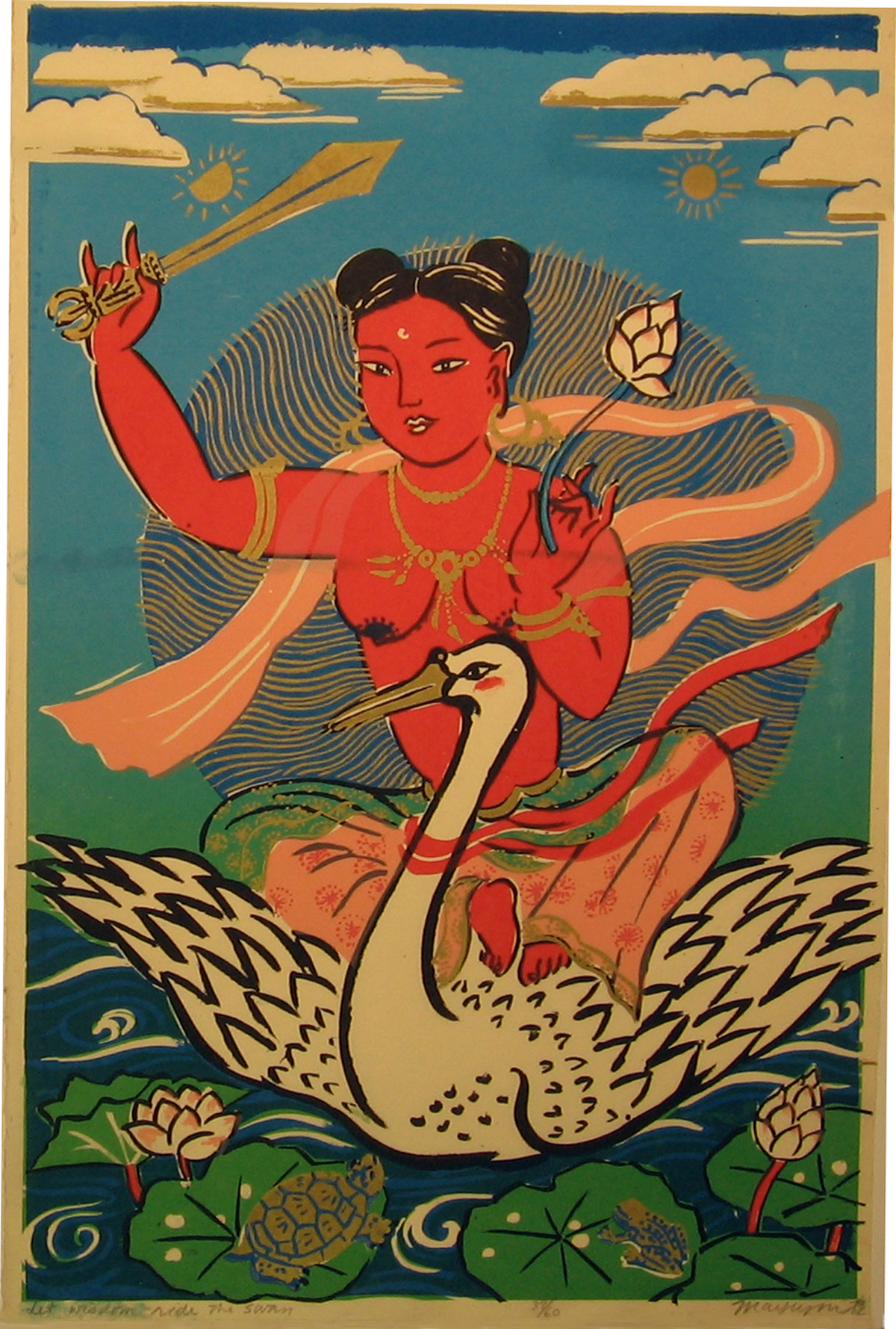
Let Wisdom Ride the Swan
Mayumi Oda

I’ve been a fan of  Buddhist artist Mayumi Oda for years and was delighted to discover the above painting. I suspect it’s at least partly inspired by the Hindu goddess Saraswati.  And since I drew parallels between Patanjali III and Saraswati at class last week, I thought it fitting to include this image with today’s  post. We’re staying with Patanjali III, 1-3, awhile longer. Here they are in phonetic Sanskrit with English translation. If you’d like a PDF of the class handout with correctly transliterated Sanskrit, please email me: suzingreen@gmail.com

1. 
Desha bandash cittasya dhaaranaa 
Concentration locks consciousness on a single area.

2. 
Tatra pratyaya ekataanataa dhyaanam
In meditative absorption, the entire perceptual flow is aligned with that object.

3.
Tadeva artha maatra nirbhaasam svaruupa shunyam iva samaadi
When only the essential nature of the object shines forth, as if formless, integration has arisen.

Last week’s (6/18) talk runs 16 minutes.

I opened with this quote from Lawrence Durrell: “It is not meaning that we need but sight.” He could have been talking about III,3:  

Tadeva artha maatra nirbhaasam svaruupa shunyam iva samaadi
When only the essential nature of the object shines forth, as if formless, integration has arisen.

When only the essential nature of the object shines forth, then, sight becomes possible. The sight that moves us beyond meaning.  Meaning can only take us so far. When we seek it as the goal, we’re attempting to order the Mystery.  And that is never gonna happen. What we want is sight. Sight breaks everything open. And in that opening, we see.

I highly recommend chanting these three sutras. And while you’re chanting, use your focus to merge with the sound. Let meaning dissolve.  And see what happens…

Here’s a clip of last week’s chanting:

And the poems: I’m reveling in Mary Oliver’s new collection, Swan. Some critique her work as simplistic. If one seeks meaning, perhaps it is. If it’s sight however, it’s shining forth, nirbhaasa, from every word.

1.
I worried a lot. Will the garden grow, will the rivers
flow in the right direction, will the earth turn
as it was taught, and if not, how shall
I correct it?

Was I right, was I wrong, will I be forgiven,
can I do better?

Will I ever be able to sing, even the sparrows
can do it and I am, well,
hopeless.

Is my eyesight fading or am I just imagining it,
am I going to get rheumatism,
lockjaw, dementia?

Finally I saw that worrying had come to nothing.
And gave it up. And took my old body
and went out into the morning,
and sang.

2.
If you suddenly and unexpectedly feel joy,
don’t hesitate. Give in to it. There are plenty
of lives and whole towns are destroyed or about
to be. We are not wise, and not very often
kind. And much can never be redeemed.
Still, life has some possibility left. Perhaps this
is its way of fighting back, that sometimes,
something happens better than all the riches
or power in the world. It could be anything,
but very likely you notice it in the  instant
when love begins. Anyway, that’s often the
case. Anyway, whatever it is, don’t be afraid
of its plenty.  Joy is not made to be a crumb.


Finally, here’s an audio clip of the above poem and closing thoughts for the evening:

Monday, June 18, 2012


We’re back to Patanjali, making our way through Book 3, The Extraordinary Powers [Vibhuti Pada] of the Yoga-Sutra. This pada concerns itself with the final three limbs of  classical Yoga: concentration [dharana], meditation [dhyana], and integration [samdhi] – and devotes a major portion of the text to the powers [siddhi] that accrue as meditation stabilizes into pure awareness.  While acquiring siddhis is a motivating force for many seekers, the harsh truth is the pursuit of power is a slippery slope. The challenge – what some would call the test – is to touch those siddhis and keep on walking. Although vibhuti is often translated as “extraordinary” or “supernatural powers,” I prefer the literal meaning: “that which extends far.”  More on that in the dharma talk excerpted below.

Here are the sutras we read last week:

III, 1
Concentration locks consciousness on a single area

III, 2
In meditative absorption, the entire perceptual flow is aligned with that object

III, 3
When only the essential nature of the object shines forth, as if formless, integration has arisen.

Here’s an excerpt from my talk:

Here’s a clip of chanting the new sutras:

Here’s the dharana I gave before meditation:

*******

Finally,  here are the Mary Oliver poems I read at class. This first one strikes me as a near perfect articulation of vibhuti….. The second, well read it and see what you think. From where I sit, it’s all about living the non-dual life, what some circles refer to sahaj samadhi, samadhi with open eyes!!!

April

I wanted to speak at length about
the happiness of my body and the
delight of my mind for it was
April, night, a
full moon and —

but something in myself or maybe
from somewhere other said: not too
many words, please, in the
muddy shallows the

frogs are singing.


For Example

Okay, the broken gull let me lift it
from the sand.
Let me fumble it into a box, with the
lid open.
Okay, I put the box into my car and started
up the highway
to the place where sometimes, sometimes not,
such things can be mended.

The gull at first was quiet.
How everything turns out one way or another, I
won’t call it good or bad, just
one way or another.

Then the gull lurched from the box and onto
the back of the front seat and
punched me.
Okay, a little blood slid down.

But we all know, don’t we, how sometimes
things have to feel anger, so as not
to be defeated?

I love this world, even in its hard places.
A bird too must love this world,
even in its hard places.
So, even if the effort may come to nothing,
you have to do something.

It was, generally speaking, a perfectly beautiful
summer morning.
The gull beat the air with its good wing.
I kept my eyes on the road.

November 22, 2010

Here’s this week’s Dharma Talk, along with posts of  readings:

39.
In harmony with the Tao,
the sky is clear and spacious,
the earth is solid and full,
all creatures flourish together,
content with the way they are,
endlessly repeating themselves,
and endlessly renewed.

When man interferes with the Tao,
the sky becomes filthy,
the earth becomes depleted,
the equilibrium crumbles,
creatures become extinct.

The Master views the parts with compassion,
because he understands the whole.
His constant practice is humility.
He doesn’t glitter like a jewel
but lets himself be shaped by the Tao,
as rugged and common as a stone.

As I said in my talk, we’ve moved into a section of the Tao Te Ching that seems very much its own. While I’m still able to find parallel teachings, they don’t flow as seamlessly from text to text as we’ve found in earlier verses. I suspect this has something to do with the construction of the Tao Te Ching. Since I’m not making a formal academic study however, I’ll  dispense with literary theory and simply post readings I found to be of a similar mind…

This first is a lovely quote from the great Sivananda, in Georg Feuerstein’s pocket anthology, Teachings of Yoga:

Smile with the flower and the green grass. Play with the butterflies, birds, and deer. Shake hands with the shrubs, ferns, and twigs of trees. Talk to the rainbow, wind, stars, and the sun. Converse with the running brooks and the waves of the sea, Speak with the walking-stick. Develop friendship with all your neighbors, dogs, cats, cows, human beings, trees, flowers, etc. Then you will have a wide, perfect, rich, full life. You will realize the oneness or unity of life. This can hardly be described in words. You will have to feel this yourself.

I was also struck by these lines from Rumi, pulled from a larger work in the Coleman Barks/Michael Green collaboration, The Illuminated Rumi:

Bend, Tend, Disappear

This is how you change
when you go to the orchard
where the heart opens….

you become
fragrance and the light
that burning oil gives off,

long strands of grieving hair, lion
and at the same time, gazelle.

You’re walking alone without feet,
as riverwater does….

Bend like the limb of a peach tree.
Tend those who need help.
Disappear three days with the moon.

Don’t pray to be healed, or look for evidence
of “some other world.”
You are the soul
and the medicine for what wounds the soul.

And in closing, as has often happened on this inter-spiritual adventure called Monday Night Class, the final word goes to Mary Oliver, whose poet-mind roams deep in the diamond essence of the Tao. Every word and every space between those words, shimmering with light and the fertile darkness…

This World

I would like to write a poem about the world that has in it
nothing fancy.
But it seems impossible.
Whatever the subject, the morning sun
glimmers it.
The tulip feels the heat and flaps its petals open
and becomes a star.
The ants bore into the peony bud and there is the dark
pinprick well of sweetness.
As for the stones on the beach, forget it.
Each one could be set in gold.
So I tried with my eyes shut, but of course the birds
were singing.
And the aspen trees were shaking the sweetest music
out of their leaves.
And that was followed by, guess what, a momentous and
beautiful silence
as comes to all of us, in little earfuls, if we’re not too
hurried to hear it.
As for spiders, how the dew hangs in their webs
even if they say nothing, or seem to say nothing.
So fancy is the world, who knows, maybe they sing.
So fancy is the world, who knows, maybe the stars sing
too, and the ants, and the peonies, and the warm
stones,
so happy to be where they are, on the beach, instead of
being lock up in gold.

July 12, 2010

Class returned to PCYH this week.  A joyous homecoming.  PCYH holds so many great memories. We held the first Devi Yoga unTraining here. And before that, so many incredible workshops and retreats. The incomparable Devi Raves happened here. Along with Bliss Cafe and outdoor fire ceremonies. It is very good to be back.

Here’s this week’s reading:

23.
Express yourself completely,
then keep quiet.
Be like the forces of nature:
when it blows, there is only wind;
when it rains, there is only rain;
when the clouds pass, the sun shines through.

If you open yourself to the Tao,
you are at one with the Tao
and you can embody it completely.
If you open yourself to insight,
you are at one with insight,
and you can use it completely.
If you open yourself to loss,
you are at one with loss
and you can accept it completely.

Open yourself to the Tao,
then trust your natural responses;
and everything will fall into place.

The Tao Te Ching is truly a sublime text. It expresses the most profound with utter simplicity and ease.  What it doesn’t do though is offer step-by-step instructions for how one actually opens to the Tao.  It’s like an impressionistic painting. We can sense the truth pulsing through the lines. We can feel uplifted as we read. And in all of that, there is opening into the vast open space called Tao.   However, if we want a hands-on guide, I suspect Patanjali-Yoga-Sutra is the text to go to. It’s offers more of a paint-by-numbers approach. And I don’t mean that in a flip way. It’s one of the most concise and essential collections of practical and experiential psychology I’ve ever encountered.  Whereas Tao Te Ching inspires us to open into our Tao nature, Patanjali explains exactly how to do this.  Here are few sutras from the first chapter. I read these at class to complement the main reading. At this point, I’m more interested in showing parallels between what Tao Te Ching calls Tao and Yoga calls Self.  We’ll be diving into this text when we complete our journey through the Tao Te Ching.

1,2
Yoga is experienced in that mind which has ceased to identify itself with its vacillating waves of perception
[aka thoughts].

1,3
When this happens, then the Seer is revealed, resting in its own essential nature, and one realizes the True Self.

1, 48
Therein dwells a luminous wisdom that upholds the essence of truth.

1,51
When the mind becomes free from obstruction, all vacillations cease, and the mind becomes absorbed into spirit…. Thus a new mind is born of this wisdom….

I couldn’t leave off these readings without quoting a few lines from Shankaracharya’s  Six Stanzas on Salvation.  The Tao Te Ching suggests, Patanjali-Yoga-Sutra advises, and Shankaracharya is simply there:

Shankaracharya Six Stanzas on Salvation

1.
I am neither the conscious nor the unconscious mind, neither intelligence nor ego, neither the ears nor the tongue not the senses of smell and sight, neither either nor air nor fire nor water nor earth, I am consciousness and bliss. I am Shiva! I am Shiva!

6.
I am without thought, without form. I am all-pervasive, I am everywhere, yet I am beyond all senses. I am neither detachment nor salvation nor anything that could be measured. I am consciousness and bliss. I am Shiva! I am Shiva!