Monday, July 9, 2012

This week’s class focused on one sutra. I thought the dawning of wisdom deserved an evening unto itself.

III, 5
Once the perfect discipline of consciousness is mastered,
wisdom dawns.
Just to reiterate, Patanjali’s Book III concerns itself with the final three limbs of classical yoga:  concentration (dharana), meditation/absorption (dhyana) and integration (samadhi). These three limbs form the perfect discipline of consciousness, aka samyama, referred to in the above sutra.
If you imagine the mind/body system as myriad layers of consciousness, some clear, some dense, some hard, some soft, some open, some closed, some sticky, some slippery — you get where I’m going with this — you can see why it’s so hard to get the whole mess integrated. All this to say the practice of samyama  does not come easily. We have to work at it. The mind is a slippery instrument, more often attuned to the kleshas, than its innate wisdom. [Should you want to review the kleshas, go to the May 2011 archive]. Yet wisdom, like the sun, is always blazing. We may be oblivious to its light. That doesn’t mean it’s not here. Which is why taking a moment to turn within can evoke a profound sense of clarity, calm, insight, or wisdom. Of course, Patanjali’s technology for yoking the mind/body system is designed so those moments of clarity, calm, insight, and wisdom stretch into the norm.
This week’s dharma talk attempts to unpack some of the above:
For reasons that will become clear over the next few weeks, I’m feeling a connection between the teachings and practices I’ve come to call the Laksmi Work and our current immersion in Patanjali Book III. More on that as it unfolds. For now, suffice to say we opened class chanting the Laksmi-Murti-Mantra combined with the Dhumavati Bija. I’ll write these mantras out for those unfamiliar with them and also include a clip of the actual chanting:
Here are the mantras:
Here’s an audio clip of the chanting:
Contemplating wisdom inspired me to go down the rabbit hole of parallel teachings:
From the Laksmi Tantra:
I am recognized by the wise as the bliss and tranquility inherent in each state of being. Though that is my true nature, [the individual] does not experience me spontaneously. However, after receiving a mere particle of my anugrahashakti [grace], she discovers me instantaneously…Then after propitiating me by various means [i.e. samyama], the jiva [individual soul] washes away all the kleshas and blows away the dust of impressions; whereby the jiva that has already severed its fetters through meditation, fuses with true knowledge [aka wisdom] and attains me, who am Laksmi and whose nature is supreme bliss.
From the Jneshwari:

 What is action? What is inaction? Thus, even the wise are confused in this matter. This action, I shall explain to you, having known which, you shall be released from evil [i.e. the lack of wisdom].

 One must know the nature of action, the nature of wrong action, and also the nature of inaction. The way of action is profound.

 He who perceives inaction in action, and action is inaction is wise among men; he is is a yogi and performs all actions.

 Such a person seems like other people, but he is not affected by human nature like the sun which cannot be drowned in water.

 He sees the world without seeing it, does everything without doing it, and enjoys all pleasures without being involved in them.

 Though he is seated in one place, he travels everywhere, for even while in the body he has become the universe.

From the Ashtavakra Gita:

1.
The wise man knows the Self,
And he plays the game of life.
 
But the fool lives in the world
Like a beast of burden.
 

2.
The true seeker feels no elation,
Even in that exalted state
Which Indra and all the gods
Unhappily long for.
 

3.
He understands the nature of things.
 
His heart is not smudged
By right or wrong,
As the sky is not smudged by smoke.
 

4.
He is pure of heart,
He knows the whole world is only the Self…
 

5.
Of the four kinds of being…
Only the wise man is strong enough
To give up desire and aversion.

From Lalleshwari , tr. by Coleman Barks

The soul, like the moon,
is new, and always new again.

And I have seen the ocean
continuously creating.

Since I scoured my mind
and my body, I too, Lalla,
am new, each moment, new.

My teacher told me one thing,
Live in the soul.

When that was so,
I began to go naked,
and dance.

Trying to be Thoughtful in the First Brights of Dawn
-Mary Oliver

I am thinking, or trying to think, about all the
imponderables for which we have
no answers, yet endless interest all the
range of our lives, and it’s

 
good for the head no doubt to undertake such
meditation; Mystery, after all,
is God’s other name, and deserves our

 
considerations surely. But, but —
excuse me now, please; it’s morning, heavenly bright,
and my irrepressible heart begs me to hurry on
into the next exquisite moment.

[w/ humble apologies to MO for this blog template’s refusal to format her poem as written…] 
Sunday, July 8, 2012, Part II

Here are notes from July 2, last week’s class. The sutra for the evening was:

III, 4
Concentration, absorption, and integration regarding a single object
compose the perfect discipline of consciousness.
For as long as Monday Night Class has gathered in Princeton, which is well over ten years now, we’ve chanted the mantra Om Namah Shivaya as a vehicle for meditation. In the spirit of this sutra however, I thought it would be interesting to work with the mantra, less as a vehicle, more as that single object Patanjali is referring to. For a group of chanting  bhaktas, this is a more difficult practice. And in that way I think, very fruitful.
Here’s my dharma talk for this class:
 And here are the parallel readings. The first is from Thomas Byrom’s gorgeous translation of the Ashtavakra Gita, a text that pulsates with the life force of samadhi:

Dissolving
 
1
You are pure.
Nothing touches you.
What is there to renounce?
 
Let it all go,
The body and the mind.
 
Let yourself dissolve.
 

2
Like bubbles in the sea,
All the worlds arise in you.
 
Know you are the Self.
Know you are one.
 
Let yourself dissolve.
 

3
You see the world.
But like the snake in the rope,
It is not really there.
 
You are pure.
 
Let yourself dissolve.
 

4
You are one and the same
In joy and sorrow,
Hope and despair,
Life and death.
 
You are already fulfilled.
 
Let yourself dissolve.

And as often happens, I give the final word to Mary Oliver, whose poetry pulsates with the life force of waking up:

The Poet is Told to Fill Up More Pages
Mary Oliver

But, where are the words?
Not in my pocket.
Not in the refrigerator.
Not in my savings account.
So I sit, harassed, with my notebook.
It’s a joke, really, and not a good one.
For fun I try a few commands myself.
I say to the rain, stop raining.
I say to the sun, that isn’t anywhere nearby,
Come back, and come fast.

Nothing happens.
So this is all I can give you,
not being the maker of what I do,
but only the one that holds the pencil.

abcdefghijklmnopqrstuvwxyz
Make of it what you will.

Sunday, July 8, 2012

I’m a couple of weeks behind here, posting notes from June 25th. That class continued our focus on Patanjali III, 1-3. I think one could stay with these sutras for a long time and only begin to penetrate the depth of the teaching. They do, after all, articulate the final limbs of classical Yoga: concentration, meditation, and samadhi. It’s really all here in these three.

For many years, I was caught up in a notion of samadhi as the final limb of Yoga, and as that “final limb,” a mostly unattainable state. We might have moments, even hours, in samadhi, but sooner or later, consciousness would shift back into something more normal and the elusive samadhi would once again be just outside our grasp.

It’s only now, studying Chip Hartranft’s brilliant version of the Yoga-Sutra, that I begin to understand samadhi, not as a state, but as a practice, not as a noun, but as a verb. He chooses to translate the word samadhi as “integration.” And integration is something we can practice every moment. Integration is waking up to the truth of who and what we are. When we wake up in the moment, when we re-member ourself to the Self, we  integrate into integration.

3.
Tadeva artha maatra nirbhaasam svaruupa shunyam iva samaadi
When only the essential nature of the object shines forth, as if formless, integration has arisen.

Yes, when only the essential nature of the object (the Self) shines forth, integration has arisen. Conversely, practicing integration, re-membering ourSelf, creates the fertile ground wherein the essential nature of the object, aka our essential nature, can shine forth. When the mind breaks open, when we shift into the shining forth, nirbhaasam,  integration, aka samadhi is happening. And that possibility is available to us in any moment. It’s not something to strive for or hope to attain. It’s another form of breathing.

Here’s my dharma talk on this topic:

Here’s the dharana I gave:

And this is a very short clip on the practice of swadhaya (concentration) before chanting:

Monday, June 25, 2012

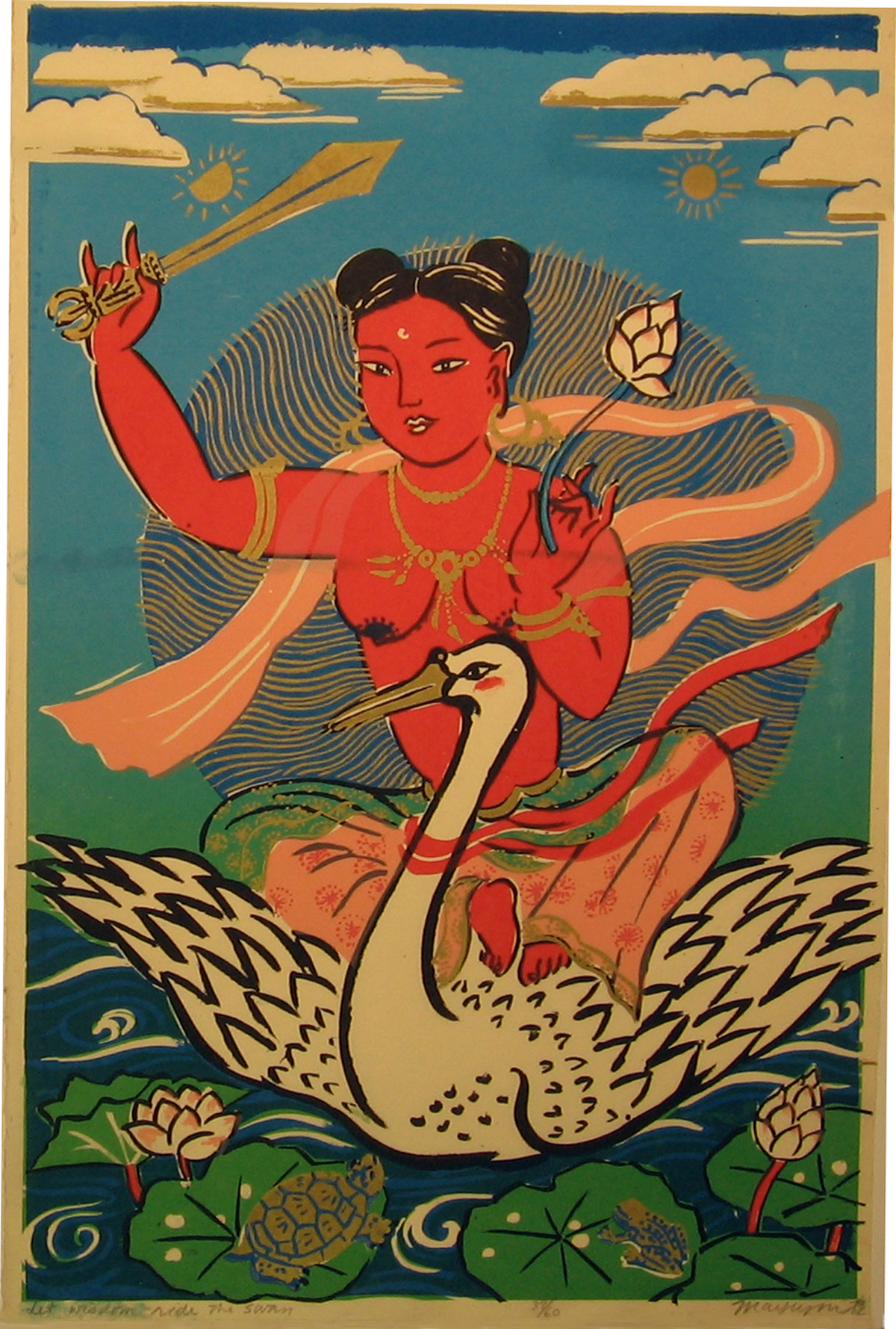
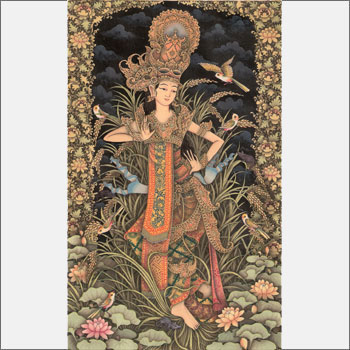
Let Wisdom Ride the Swan
Mayumi Oda

I’ve been a fan of  Buddhist artist Mayumi Oda for years and was delighted to discover the above painting. I suspect it’s at least partly inspired by the Hindu goddess Saraswati.  And since I drew parallels between Patanjali III and Saraswati at class last week, I thought it fitting to include this image with today’s  post. We’re staying with Patanjali III, 1-3, awhile longer. Here they are in phonetic Sanskrit with English translation. If you’d like a PDF of the class handout with correctly transliterated Sanskrit, please email me: suzingreen@gmail.com

1. 
Desha bandash cittasya dhaaranaa 
Concentration locks consciousness on a single area.

2. 
Tatra pratyaya ekataanataa dhyaanam
In meditative absorption, the entire perceptual flow is aligned with that object.

3.
Tadeva artha maatra nirbhaasam svaruupa shunyam iva samaadi
When only the essential nature of the object shines forth, as if formless, integration has arisen.

Last week’s (6/18) talk runs 16 minutes.

I opened with this quote from Lawrence Durrell: “It is not meaning that we need but sight.” He could have been talking about III,3:  

Tadeva artha maatra nirbhaasam svaruupa shunyam iva samaadi
When only the essential nature of the object shines forth, as if formless, integration has arisen.

When only the essential nature of the object shines forth, then, sight becomes possible. The sight that moves us beyond meaning.  Meaning can only take us so far. When we seek it as the goal, we’re attempting to order the Mystery.  And that is never gonna happen. What we want is sight. Sight breaks everything open. And in that opening, we see.

I highly recommend chanting these three sutras. And while you’re chanting, use your focus to merge with the sound. Let meaning dissolve.  And see what happens…

Here’s a clip of last week’s chanting:

And the poems: I’m reveling in Mary Oliver’s new collection, Swan. Some critique her work as simplistic. If one seeks meaning, perhaps it is. If it’s sight however, it’s shining forth, nirbhaasa, from every word.

1.
I worried a lot. Will the garden grow, will the rivers
flow in the right direction, will the earth turn
as it was taught, and if not, how shall
I correct it?

Was I right, was I wrong, will I be forgiven,
can I do better?

Will I ever be able to sing, even the sparrows
can do it and I am, well,
hopeless.

Is my eyesight fading or am I just imagining it,
am I going to get rheumatism,
lockjaw, dementia?

Finally I saw that worrying had come to nothing.
And gave it up. And took my old body
and went out into the morning,
and sang.

2.
If you suddenly and unexpectedly feel joy,
don’t hesitate. Give in to it. There are plenty
of lives and whole towns are destroyed or about
to be. We are not wise, and not very often
kind. And much can never be redeemed.
Still, life has some possibility left. Perhaps this
is its way of fighting back, that sometimes,
something happens better than all the riches
or power in the world. It could be anything,
but very likely you notice it in the  instant
when love begins. Anyway, that’s often the
case. Anyway, whatever it is, don’t be afraid
of its plenty.  Joy is not made to be a crumb.


Finally, here’s an audio clip of the above poem and closing thoughts for the evening:

Monday, June 18, 2012


We’re back to Patanjali, making our way through Book 3, The Extraordinary Powers [Vibhuti Pada] of the Yoga-Sutra. This pada concerns itself with the final three limbs of  classical Yoga: concentration [dharana], meditation [dhyana], and integration [samdhi] – and devotes a major portion of the text to the powers [siddhi] that accrue as meditation stabilizes into pure awareness.  While acquiring siddhis is a motivating force for many seekers, the harsh truth is the pursuit of power is a slippery slope. The challenge – what some would call the test – is to touch those siddhis and keep on walking. Although vibhuti is often translated as “extraordinary” or “supernatural powers,” I prefer the literal meaning: “that which extends far.”  More on that in the dharma talk excerpted below.

Here are the sutras we read last week:

III, 1
Concentration locks consciousness on a single area

III, 2
In meditative absorption, the entire perceptual flow is aligned with that object

III, 3
When only the essential nature of the object shines forth, as if formless, integration has arisen.

Here’s an excerpt from my talk:

Here’s a clip of chanting the new sutras:

Here’s the dharana I gave before meditation:

*******

Finally,  here are the Mary Oliver poems I read at class. This first one strikes me as a near perfect articulation of vibhuti….. The second, well read it and see what you think. From where I sit, it’s all about living the non-dual life, what some circles refer to sahaj samadhi, samadhi with open eyes!!!

April

I wanted to speak at length about
the happiness of my body and the
delight of my mind for it was
April, night, a
full moon and —

but something in myself or maybe
from somewhere other said: not too
many words, please, in the
muddy shallows the

frogs are singing.


For Example

Okay, the broken gull let me lift it
from the sand.
Let me fumble it into a box, with the
lid open.
Okay, I put the box into my car and started
up the highway
to the place where sometimes, sometimes not,
such things can be mended.

The gull at first was quiet.
How everything turns out one way or another, I
won’t call it good or bad, just
one way or another.

Then the gull lurched from the box and onto
the back of the front seat and
punched me.
Okay, a little blood slid down.

But we all know, don’t we, how sometimes
things have to feel anger, so as not
to be defeated?

I love this world, even in its hard places.
A bird too must love this world,
even in its hard places.
So, even if the effort may come to nothing,
you have to do something.

It was, generally speaking, a perfectly beautiful
summer morning.
The gull beat the air with its good wing.
I kept my eyes on the road.

Friday, May 25, 2012

I’ve just returned from six weeks in California, helping with end of life care for my 96-year old mom. I flew out expecting to stay one week. Life (and near-death) however, had other plans. Although much of my time was spent care-giving, I was able to edit some talks for this blog. You’ll find the first of those below. One of these days the demands of family dharma will abate and I’ll return to regular blogging. In the meantime, my posts will continue haphazard, with little semblance of rational order.

The last two posts referenced December 5th’s class on Patanjali Book II, 43-45. I’m now jumping ahead to II, 54-55. These are the final sutras of Book II and describe the practice of pratyahara, withdrawal of the senses.

54.
When consciousness interiorizes by uncoupling from external objects,
the senses do likewise; this is called withdrawal of the senses.
55.
Then the senses reside utterly in the service of realization.

This talk, given at class on January 30, focused on pratyahara and mindfulness. It’s rather freewheeling in its intensity with some hilarious moments. Below the sound clip you’ll find text of the Mary Oliver poems I read that night. The talk runs 29 minutes.

This first poem is a gorgeous exclamation of the senses in service of realization; the second, a darker telling of those moments when the senses run rampant over connection to the Self:

1.
Hello, sun in my face.
Hello, you who made the morning
and spread it over the fields
and into the faces of the tulips
and the nodding morning glories,
and into the windows of, even, the
miserable and the crotchety –
best preacher that ever was,
dear star, that just happens
to be where you are in the universe
to keep us from ever-darkness,
to ease us with warm touching,
to hold us in the great hands of light –
good morning, good morning, good morning.
Watch, now, how I start the day
in happiness, in kindness.

2.
The arrowhead,
which I found beside the river,
was glittering and pointed.
I picked it up, and said,
“Now, it’s mine.”
I thought of showing it to friends.
I thought of putting it—such an imposing trinket—
in a little box, on my desk.
Halfway home, past the cut fields,
the old ghost
stood under the hickories.
“I would rather drink the wind,” he said,
“I would rather eat mud and die
than steal as you steal,
than lie as you lie.”

PCYH @ Orchard Hill Center in Skillman, NJ

Beginning on Monday, 1/23/12, Monday Night Class moves to the new Princeton Center for Yoga & Health:

PCYH @ Orchard Hill Center
88 Orchard Road
Skillman, NJ 08558


In beauty may I walk
All day long may I walk
Through the returning seasons may I walk….
With dew about my feet may I walk
With beauty before me may I walk
With beauty behind me may I walk
With beauty above me may I walk
With beauty all around me may I walk
It is finished in beauty
-Navaho Beauty Way

Please use this link for map & directions:

http://princetonyoga.com/directions-to-pcyh/


Monday, December 5, 2011, Part II

I brought in three short readings to complement tonight’s sutras. Each offers a counterpoint to the sutra. The first, from Lalla goes beautifully with II, 43:  As intense discipline burns up impurities, the body and its senses become supremely purified.

The steed called mind roams space,
covering one hundred thousand miles
in the blink of an eye.
He who does not know how to tether it
is apt to be battered to death
by the inbreath and the outbreath.
-Lalla

The second, from Swami Vivekananda has an interesting resonance with              II, 44:   Self-study deepens communion with one’s personal deity.

If there is any road to Heaven, it is through Hell. Through Hell to Heaven is always the way. When the soul has wrestled with circumstance and has met death, a thousand times death on the way, but nothing daunted has struggled forward again and again and yet again — then the soul comes out as a giant and laughs at the ideal he has been struggling for, because he finds how much greater is he than the ideal. 
-Swami Vivekananda

The third pairs nicely with II, 45:  Through orientation toward the ideal of pure awareness, one can achieve integration.

What stands in the way of course is always the vital ego with its ignorance and the pride of its ignorance and the physical consciousness with its inertia which resents and resists any call to change and its indolence which does not like to take the trouble — finds it more comfortable to go on its own way repeating always the same old movements and, at best, expecting everything to be done for it in some way or at some time.
-Sri Aurobindo

Here’s the sound clip of these readings:

Monday, December 5, 2011

We’ve circled back to Patanjali, returning to where we left off during the summer, Book II, 43-45. These sutras elaborate the last three niyamas–which Patanjali classifies as kriya-yoga (aka, the Yoga of Action.) Remember, the niyamas, which we can think of as internal disciplines are considered  the second limb of Yoga. The yamas or external disciplines are the first. Here are the sutras:

[Chip Hartranft’s version]

II, 43
As intense discipline burns up impurities, the body and its senses become supremely purified.
II,  44.
Self-study deepens communion with one’s personal deity.
II, 45
Through orientation toward the ideal of pure awareness, one can achieve integration.

Since many at class asked me to post this talk asap, I’ve done minimal editing. I usually remove extraneous laughter, asides, etc. This clip leaves most of that in. Since the talk was composed of three sections, I’ve divided the clips accordingly.

Here’s the main Dharma Talk on Sutras II 43-45, aka Kriya-Yoga:

Here’s the clip citing Nischala Joy Devi’s translation and connecting of Gayatri Mantra with these three sutras:

The third clip contains quotes I read at the end of my talk.  I’ll post that clip along with the text in a few days.

Finally, here’s a lovely quote to inspire your week…

It is not meaning that we need but sight…    
-Lawrence Durrell

October 31, 2011


Since this week’s class fell on Halloween, I was moved to acknowledge Samhain, the ancient Celtic holiday from which our modern celebration springs.

Here are Samhain blessings I read at class:

May wonder ever illumine your souls as the candle does a room on a long, winter night, may joy blow through your heart with the intensity of the north wind in a blizzard, may peace cover your lives like a blanket of fresh fallen snow.

May you have the hindsight to know where you’ve been, the foresight to know where you are going, and the insight to know when you have gone too far…

May the road rise up to meet you, may the wind be ever at your back. May the sun shine warm upon your face and the rain fall softly on your fields. And until we meet again, may you be held in the hands of Grace.

Harry Potter notwithstanding, Samhain’s special connection to the Dark Goddess has been distorted in our Halloween iconography of witches on broomsticks. It is however, a night to honor the Dark Mother, so I opened class with a medley of Kali chants. Here’s the dharma talk that followed that soaring flight of luminosity…